


Next LTC Halving Date: When Litecoin Block Rewards Drop From 6.25 to 3.125 LTC

Updated: Mar 27, 2026


Introduction
Litecoin has a built-in countdown clock that keeps ticking in the background of every transaction. Roughly every four years, that clock hits zero and the network slices miner rewards in half. The next Litecoin halving will cut the block reward from 6.25 LTC to 3.125 LTC, and it is currently projected for late July/early August 2027 at block height 3,360,000.
LTC halving matters for more than just miners. Litecoin has a capped supply of 84 million coins and a fixed schedule that reduces new issuance over time, which feeds directly into scarcity narratives and long-term valuation debates.
Disclaimer: This is educational content, not financial advice. Crypto markets are volatile and speculative. Always do your own research (DYOR), consider risk tolerance and time horizon, and never invest money that you can’t afford to lose.
To set the stage, here is the current market snapshot for LTC:
Stock Market Information for Litecoin (LTC)
-
The price of Litecoin is 83.43 USD as of December 8, with a rise of 1.91% in the last 24h. (as per CoinMarketCap)
In this guide, we will walk through how Litecoin halving works, look at the LTC halving chart (with LTC halving dates and key numbers), why the 2027 event cuts rewards from 6.25 to 3.125 LTC, how past halvings played out, and what the long-term schedule looks like. We will close with practical insights for users and investors preparing for the next cycle.
What is Litecoin Halving?
Think of it as a monetary schedule baked into code rather than decided by a committee.
The Halving Mechanism
Litecoin runs on proof-of-work, where miners bundle transactions into blocks and receive a block reward paid in LTC. When Litecoin launched in October 2011, the LTC block reward stood at 50 LTC per block. Over time, the protocol automatically halves that reward after every 840,000 blocks.
With an average block time of about 2.5 minutes, those 840,000 blocks land roughly every four years. That pattern produced a reward path from 50 LTC to 25 LTC in 2015, then 12.5 LTC in 2019, and 6.25 LTC after the most recent Litecoin halving date: August 2023.
This design mirrors Bitcoin’s halving concept, although Bitcoin halves every 210,000 blocks with a 10-minute block time. Litecoin scales that idea to a faster chain with four times the total supply – 84 million LTC instead of 21 million BTC – while keeping the same idea of predictable, periodically shrinking rewards.
Programmed Scarcity
Litecoin’s halving schedule lives in the protocol rules. No committee meeting, no yearly vote. Nodes either follow the rules that cut rewards in half at the next halving block, or they fall out of consensus and get ignored.
One way to picture this is as a staircase that never goes back up. Every 840,000 blocks, the reward drops by half. The total number of coins that will ever exist is capped at 84 million, so each halving slows the pace at which new coins enter circulation.
For miners, this promotes a shift over time from block rewards toward transaction fees. For users and investors, it turns Litecoin into a supply schedule you can map decades out, with scarcity gradually increasing as more of that 84 million supply is mined.
Next LTC Halving
Now that the basic idea is clear, we can zoom in on the next big milestone – the halving that cuts rewards from 6.25 LTC to 3.125 LTC.
Countdown to the Next Litecoin Halving Date
Multiple independent countdown trackers expect the next Litecoin halving around late July/early August 2027, when the chain reaches block height 3,360,000. Current estimates cluster around dates such as 26–30 July 2027, with some models stretching into early September, since block times fluctuate slightly around the 2.5-minute target.
At that point, the base block reward will fall from 6.25 LTC to 3.125 LTC. Inflation from new coins drops again, and the share of already-mined coins within the 84 million cap rises. Taken alone, this does not guarantee any price outcome, although it does tighten new supply in a measurable way.
Users who want a live countdown can check dedicated sites such as LitecoinBlockHalf, Coinguides’ halving timer, or LitecoinHalving.com. These services track actual block production and update the expected date in real time.
Technical Details
Litecoin’s block schedule sits at the core of every halving. With a target block time of 150 seconds and a halving interval of 840,000 blocks, the network aims for one halving roughly every four years.
By the 2027 event, Litecoin will have passed:
-
Genesis at block 0 with a 50 LTC reward in October 2011
-
First halving at block 840,000 in August 2015 – reward cut to 25 LTC
-
Second halving at block 1,680,000 in August 2019 – reward cut to 12.5 LTC
-
Third halving at block 2,520,000 in August 2023 – reward cut to 6.25 LTC
The 2027 halving at block 3,360,000 simply follows that pattern and halves rewards again, from 6.25 to 3.125 LTC. If you plotted block rewards over time, you would see an exponential decay curve: large reward drops early, then smaller absolute changes later as the reward approaches zero, while total supply inches toward 84 million.
Next Halving Price Predictions
Price forecasts around halving events range from cautious to very bold, and Litecoin is no exception. Third-party sites publish scenarios that can help with scenario planning, as long as they are treated as models, not promises.
A conservative camp includes long-range models such as LongForecast, which show Litecoin trading in the tens of dollars in 2027, with many monthly projections between roughly 45 and 75 USD.
More moderate forecasts for the next Litecoin halving event cluster in the low to mid hundreds. VentureBurn’s 2027 table lists a central target near 250 USD. Changelly’s German-language analysis points to a 2027 Litecoin price range that sits around 180–205 USD, with an average just under 190 USD. Capital.com’s roundup of third-party models mentions CoinCodex scenarios where 2027 lands near 190 USD in some paths.
At the optimistic end, TokenMetrics describes a base case around 75 USD with scenario ranges up to roughly 160 USD, while more bullish paths stretch toward 540 USD by 2027. AInvest publishes an even higher peak zone, highlighting models where Litecoin climbs into a 300–500 USD range around the 2027 halving if adoption and macro conditions align.
These ranges show how wide opinions can be. Outcomes depend on Bitcoin’s own cycle, global liquidity, regulation, merchant use of Litecoin, network activity, and plain human sentiment. No model can guarantee a result, so risk management, position sizing, and time horizon matter far more than any single price target.
Litecoin Halving History
Past halvings do not give a rulebook for the future, though they offer useful context. The early years of Litecoin looked very different from today’s more mature market.
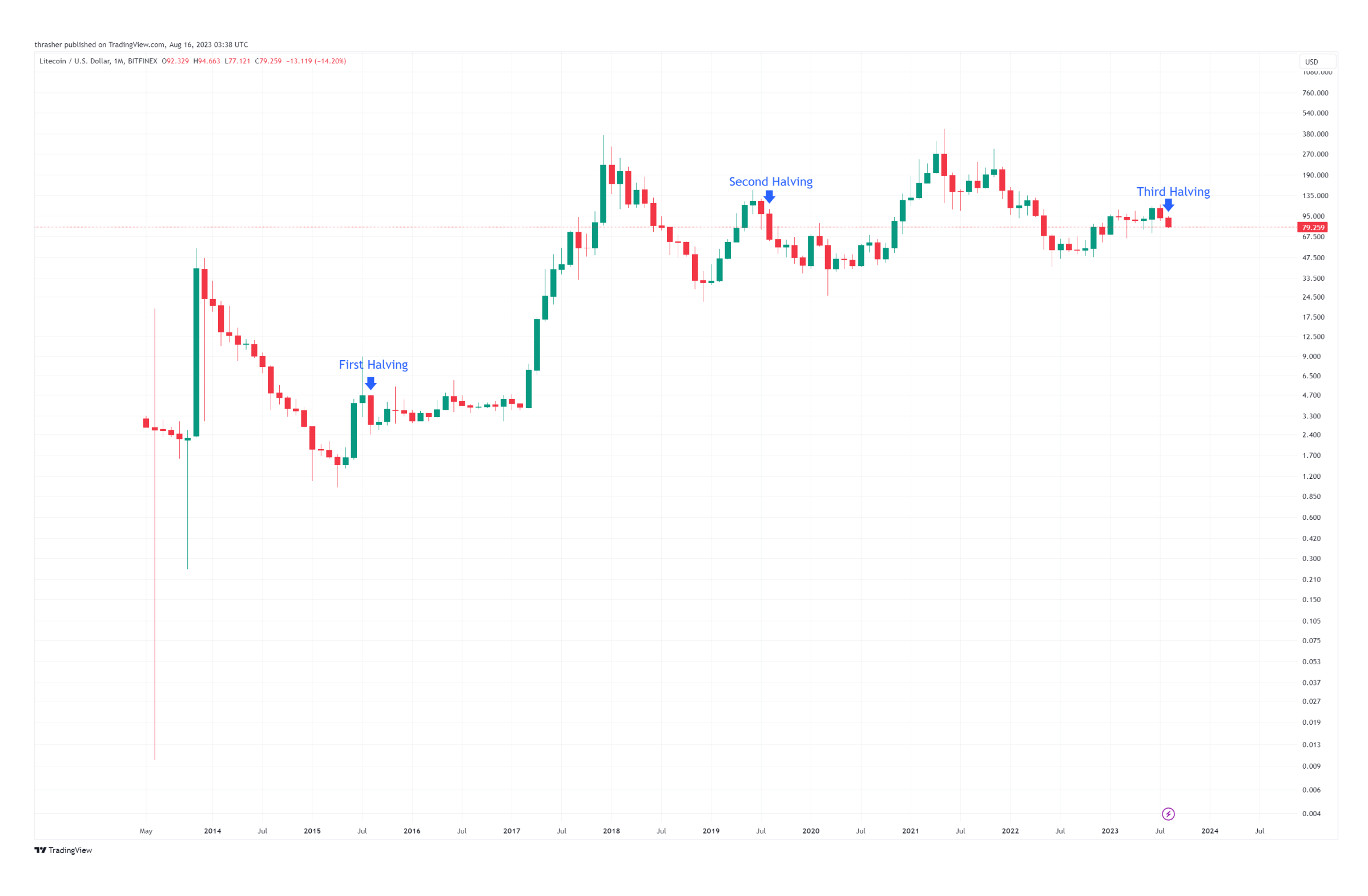
Past Litecoin halvings. Source:LitecoinBlockHalf / TradingView
2011 Litecoin Halving
In 2011, Litecoin launched with a starting reward of 50 LTC per block and a supply cap of 84 million coins. That reward level never changed in 2011 itself, yet the halving schedule already existed in the code: every 840,000 blocks, rewards would drop by half.
This design closely followed Bitcoin’s emission model, only with faster 2.5-minute blocks and lower transaction fees. Market liquidity in those early years remained thin, so most effects of the schedule showed up later, once exchanges, wallets, and on-chain activity expanded.
2015 Litecoin Halving
The first Litecoin halving, an actual one, occurred on 25 August 2015 at block height 840,000. Block rewards dropped from 50 LTC per block to 25 LTC.
Market data from that period shows a strong run-up ahead of the event. Litecoin moved from around 1–2 USD in early 2015 to a local peak near 8–9 USD in July, then cooled down and traded near 3 USD around the halving itself.
Infrastructure at the time of the halving was far smaller, with limited derivatives, fewer exchanges, and less institutional attention, so price swings reflected a mix of speculation and thin order books.
2019 Litecoin Halving
The second Litecoin halving took place on 5 August 2019 at block height 1,680,000, cutting rewards from 25 LTC per block to 12.5 LTC per block.
In the months before the event, Litecoin rallied from around 75 USD to a peak above 140 USD in June, then pulled back sharply into the halving, trading near 100 USD at the time of the reward cut.
This pattern (strength ahead of the halving, then cooling afterwards) attracted attention, yet it still lined up with broader crypto market moves rather than an isolated halving effect.
2023 Litecoin Halving
The third Litecoin halving arrived on 2 August 2023, at block 2,520,000. Block rewards dropped again, this time from 12.5 LTC to 6.25 LTC.
When this halving occurred, Litecoin was a veteran asset. Derivatives markets were more developed, and data providers tracked every twist in on-chain metrics. LTC once again showed strength in the lead-up, peaking about a month before the event.
After the halving, price slipped and even dropped sharply in the first days, with one report noting an 8 percent fall within hours.
Past Litecoin Halvings: Price Trends & Reactions
Looking across 2015, 2019 and the 2023 halving event, a few recurring themes appear in historical data. In both 2015 and 2019, LTC showed price strength months before the halving, followed by consolidation or pullbacks closer to the date and in the following quarter.
Market participants often describe three phases: early accumulation and growing curiosity, pre-halving excitement with rising social media chatter, then a post-halving phase where price sometimes drifts or retraces as traders de-risk.
Analysts treat halving history as a piece of context rather than a predictive formula.
Future Halving Events
The upcoming Litecoin 2027 halving is only one step on a very long staircase. Litecoin’s code already maps out reward cuts well into the 2100s.
Expected Future Halving Dates
Halving dates are estimates because real block times wiggle around the 2.5-minute target. The schedule below uses average assumptions from public halving tables and historical timing.
Litecoin Block Reward Schedule (estimated)
|
Block reward after drop (LTC) |
Block height |
Estimated halving date* |
|
50 (genesis reward) |
0 |
October 2011 |
|
25 |
840,000 |
August 2015 |
|
12.5 |
1,680,000 |
August 2019 |
|
6.25 |
2,520,000 |
August 2023 |
|
3.125 |
3,360,000 |
Late July – Early August 2027 |
|
1.5625 |
4,200,000 |
Around 2031 |
|
0.78125 |
5,040,000 |
Around 2035 |
|
0.390625 |
5,880,000 |
Around 2039 |
|
0.1953125 |
6,720,000 |
Early 2043 |
|
0.09765625 |
7,560,000 |
Around 2047 |
|
0.048828125 |
8,400,000 |
Around 2051 |
|
… |
… |
… up to ~2142+ |
*Dates are approximate and depend on real-world block production.
Community resources such as Coinguides and BitDegree extend this table further, showing reward steps shrinking all the way past 2100, with inflation trending closer and closer to zero.
This predictable schedule helps miners, long-term investors, and infrastructure builders think in terms of multiple cycles rather than single news events.
When Will Litecoin Halving Stop?
From a mathematical angle, Litecoin’s halving never truly stops – the reward keeps cutting in half forever. In practice, at some point the reward becomes so tiny that new issuance no longer has a noticeable impact on supply.
Analysts who model the full schedule usually land near the early 22nd century as the era when nearly all of the 84 million LTC has been mined and new rewards are negligible. CoinMarketCap and other data providers point to a rough target around the year 2140–2142, similar to Bitcoin’s full-dilution timeline.
As rewards shrink, network security is expected to depend more on transaction fees. That idea mirrors the long-term vision for Bitcoin and keeps incentives in place for miners who keep validating and securing the chain.
Impact of the Halving
The 2027 reward cut touches miners, investors and the broader crypto crowd in different ways, even though the underlying code change is simple.
On Miners
For miners, halving is a direct revenue shock. The block reward for miners that was 6.25 LTC per block will now be 3.125 LTC after the 2027 event, so the gross reward per block falls by 50 percent overnight.
Litecoin miners typically respond through a mix of steps: upgrading hardware, seeking cheaper power sources, improving operational efficiency, switching part of their equipment to other coins, or leaving the market if margins turn negative.
Short-term hash rate dips can appear around halvings while unprofitable rigs shut down, although the network difficulty adjustment helps keep the chain running smoothly. Over longer periods, more efficient operators tend to survive, and hash rate can recover as conditions improve.
On Investors
For investors, halving changes the flow of new supply. Fewer newly mined coins hit the market each day, and that can support scarcity-based narratives around Litecoin as long-term money with a predictable issuance path.
That story does not guarantee price appreciation. Demand needs to grow or at least hold steady for reduced supply growth to have an impact. Thoughtful investors who follow halving cycles often:
-
Spread entries over time through dollar-cost averaging
-
Keep LTC as one part of a diversified crypto allocation
-
Size positions with the assumption that price could move sharply both up and down around key dates
Education, risk limits, and a clear personal thesis matter more than chasing headlines or trying to time a single day.
On Crypto Community
Halving events tend to turn into social milestones. As the date approaches, Litecoin discussions on X (Twitter), Reddit, forums and Discord servers usually pick up. Articles and videos about “Litecoin halving explained” spread again, drawing fresh attention to a project that otherwise moves quietly in the background.
Developers sometimes time announcements, integrations, or upgrades to these periods, since more eyes are watching the network. Exchanges and data platforms publish special reports, and newcomers often discover Litecoin through halving explainers rather than whitepapers.
Actionable Insights for LTC Investors and Users
Litecoin halving creates a clear calendar marker, not a guaranteed profit engine. For people who hold or plan to hold LTC, a few practical habits can help:
-
Treat the 2027 halving as one part of a longer multi-cycle view, not a single lottery ticket
-
Map out scenarios across conservative, moderate and optimistic price paths instead of anchoring to one bold forecast
-
Use position sizing that fits your risk tolerance so that even large swings do not force emotional decisions
-
Combine Litecoin exposure with other assets rather than going all-in on a single halving bet
None of this replaces independent research. The key idea is simple: the halving date is known in advance, so planning can be calm and methodical rather than reactive.
Round-Up
Litecoin halving sits at the center of its monetary design. From the first 50 LTC block in 2011 to the 2023 cut down to 6.25 LTC, each event has followed the same rule – every 840,000 blocks, the mining reward halves and new issuance slows.
The next step in this schedule arrives around late July 2027, when the reward drops again from 6.25 LTC to 3.125 LTC at block 3,360,000. Miners will feel an immediate hit to block revenue, investors will see fresh debate about supply shocks and long-term value, and the wider crypto community will likely revisit familiar questions about halving effects on price.
Historical data shows that Litecoin sometimes rallies ahead of halvings and cools afterwards, yet each cycle unfolded inside a broader market environment shaped by Bitcoin, macro conditions, regulation, and sentiment.
Forecasts for the upcoming LTC halving of 2027 span everything from sub-100 USD scenarios to models that place potential peaks in the high hundreds, which underlines how wide the range of outcomes can be.
If you follow Litecoin, the most productive step is preparation rather than prediction. Learn how the schedule works, review your own goals and risk limits, and keep an eye on both technical data and real-world use. The halving will arrive on chain whether the market pays attention or not – how you respond lies entirely in your hands.
Frequently Asked Questions
What is Litecoin Halving?
Litecoin halving is a scheduled event where the reward miners earn for creating a new block is cut in half, reducing the rate at which new LTC enters circulation.
How Does Litecoin Halving Work?
The Litecoin protocol includes rules that trigger a 50 percent block reward cut every 840,000 blocks, roughly every four years. With a 2.5-minute target block time and a capped supply of 84 million LTC, this schedule steadily lowers inflation as more coins are mined and shifts miner income over time toward transaction fees.
When is the Next Litecoin Halving?
Current estimates place the next Litecoin halving in late July 2027, around block height 3,360,000, when the reward will drop from 6.25 LTC to 3.125 LTC. Countdown sites update this estimate as real block times vary.
Will Litecoin Halving Increase Price?
Past cycles often showed price strength months ahead of halving events, followed by periods of cooling or consolidation, yet the pattern has not been perfectly consistent. Price reacts to many moving parts: Bitcoin’s trend, global liquidity, regulation, and adoption. Halving can support a scarcity narrative, though it does not guarantee higher prices, so risk management and time horizon matter more than any single date.
When Did Previous Litecoin Halving Events Happen?
Litecoin’s main halving milestones so far are:
-
August 25, 2015 – block 840,000 – reward cut from 50 to 25 LTC
-
August 5, 2019 – block 1,680,000 – reward cut from 25 to 12.5 LTC
-
August 2, 2023 – block 2,520,000 – reward cut from 12.5 to 6.25 LTC
Analysts often compare price and sentiment around each date, although no two cycles have matched perfectly.
Will Litecoin Reach $100?
Litecoin has already traded near and above 100 USD at various points, and several external forecasts describe future scenarios where LTC spends time around or above that level in coming years. Some models keep 2027 prices under 100 USD, others list central targets near 90–250 USD, and a few optimistic paths reach several hundred dollars, all with many assumptions.
The information in this article is not a piece of financial advice or any other advice of any kind. The reader should be aware of the risks involved in trading cryptocurrencies and make their own informed decisions. SimpleSwap is not responsible for any losses incurred due to such risks. For details, please see our Terms of Service.