


Alpacas, Pizza, and Satoshi Nakamoto WikiLeaks Warning: First Decade Bitcoin Purchases

Updated: May 22, 2026


Bitcoin Pizza Day, May 22. The SimpleSwap team revisits the strangest receipts from crypto’s first decade and what they reveal about where the market is headed next.
In 2010, Bitcoin lived on a forum, far from Wall Street’s attention. ETFs were unimaginable. Regulators didn’t know what to call it. One coin would buy you a fraction of a penny’s worth of anything outside the bitcointalk forum, and the asset itself had a market cap smaller than most local hardware stores. What it did have was a few thousand believers and one very specific question.
Could you actually buy stuff with this?
The answer turned out to be yes. Pizza, wool socks, donations to a sanctioned whistleblower, a used hybrid car, even a ticket to space. Today, those receipts read like billion-dollar inside jokes; back then, they were just Tuesday on the forum.
What you could buy with Bitcoin in 2010 was almost nothing, and that gap was exactly what made the experiments worth running. Every purchase was a real-world test of whether digital money could exit the lab. Bitcoin real-world payments history starts here, with a handful of strange transactions that quietly proved a point each.
May 22 marks Bitcoin Pizza Day. To commemorate it, the SimpleSwap team has lined up five of the most consequential weird things bought with Bitcoin, back when one coin bought a snack instead of a yacht. These are the first-decade Bitcoin purchases that shaped not just the price chart but the cultural memory of an entire industry.
Two Papa John’s Pizzas: a $1 Billion Snack
The transaction every crypto kid learns first. On May 22, 2010, Florida programmer Laszlo Hanyecz sent 10,000 BTC to Jeremy Sturdivant, who ordered two large Papa John’s pizzas in return. Bitcoin was worth roughly $41 at the time. At 2026 prices, the same coins clear over $1 billion.

The guy who bought pizza with Bitcoin wasn’t just hungry. Hanyecz was running an experiment: could digital coins actually buy a physical object? Could the network move value across state lines for something that arrived in a cardboard box? They could. Block 57,043 of the Bitcoin blockchain still records the trade, including the 1 BTC tip he added on top.
This is often called the first bitcoin transaction for goods, though technically the first transfer of bitcoin between two people happened earlier (Satoshi to Hal Finney, January 2009). The pizza order was the first time someone exchanged BTC for something you could eat. The distinction matters because it’s the moment bitcoin stopped being a closed-loop currency between developers and turned into something you could spend in the real economy.
Hanyecz didn’t stop with pizza either. Blockchain analysts have linked his wallet to roughly 100,000 BTC in spending throughout 2010, much of it on more food deliveries. He has said in interviews that he doesn’t regret it. By his logic, somebody had to test whether the network worked, and waiting until the price made the experiment expensive would have defeated the purpose.
The pizza experiment answered the question of what could you buy with Bitcoin in 2010 with a single, glorious data point: dinner, if you were patient enough to find a willing forum user.
2. Alpaca Wool Socks: How Bitcoin Got Its Mascot
In February 2011, a small farm in Haydenville, Massachusetts called Grass Hill Alpacas started accepting BTC for socks. The push came from David Forster, the owner’s son, who wanted into crypto but didn’t trust anyone enough to mail an envelope of cash for the coins.
So the family pivoted. Instead of buying Bitcoin, they would sell wool for it.
Alpaca socks Bitcoin opening price was 75 BTC per pair. By June 2011, demand had dropped the price to 5 BTC. A Slashdot post mocking the whole thing with “Do alpacas really wear socks?” turned the animal into Bitcoin’s unofficial mascot, and the phrase “alpaca-sock-wearing crypto-terrorists” stuck around in the community for years after.
The Bitcoin alpaca mascot origin story sounds like a meme, and it eventually became one. At the time, it was something more meaningful: proof that physical goods could ship from a small American farm to global buyers paying in an asset nobody recognized. No bank approved the transaction, no payment processor flagged it, no chargeback wiped it out two months later.
The farm sold out within weeks. Forster, like most early adopters, didn’t hold the coins he received. He converted them quickly, which was the smart move at the time and the regrettable one in retrospect. The same calculation has been made by countless merchants who treated bitcoin as a currency to flow through their businesses rather than as a balance-sheet asset to keep.
Today, the alpaca still shows up at crypto conferences, on X avatars, in occasional NFT projects, and in the iconography of more than one wallet brand. It earned the slot fairly.
WikiLeaks Donations: When Bitcoin Got Political
In December 2010, WikiLeaks published the U.S. State Department cables: 251,000 diplomatic messages that exposed years of internal correspondence between American embassies. Within days, Visa, Mastercard, PayPal, Western Union, and Bank of America had all cut the organization off. The WikiLeaks banking blockade killed roughly 95% of WikiLeaks’ donation income overnight. There was no court order behind it, no formal indictment, no due process attached, and no legal mechanism a small organization could realistically push back against. The whole shutdown amounted to five phone calls between five compliance departments.
Six months later, in June 2011, WikiLeaks Bitcoin donations went live. The organization published a single Bitcoin address. The community responded fast: 171 BTC arrived in the first seven days. By 2017, the Julian Assange Bitcoin stash had appreciated to the point that he was tweeting WikiLeaks had earned a 50,000% return on its bitcoin reserves, alongside a sarcastic thank-you to the U.S. government for “forcing” the move.
This was the moment crypto stopped being a hobby project.
It was also the moment the network was tested on something it wasn’t quite ready for. And that’s where the most cited piece of Bitcoin censorship resistance history comes from: Satoshi Nakamoto WikiLeaks warning.
On December 11, 2010, the day before going effectively silent, Satoshi posted on the bitcointalk forum:
“It would have been nice to get this attention in any other context. WikiLeaks has kicked the hornet’s nest, and the swarm is headed towards us.”
This became known as Satoshi Nakamoto last message to the public. A handful of small posts followed in the days after, but the WikiLeaks warning is the one historians keep coming back to. The Satoshi Nakamoto last post before disappearing wasn’t a triumphant launch announcement or a roadmap. It was a quiet, serious warning that the project wasn’t structurally ready to handle adversarial state attention.
He was right and wrong at the same time. The network did survive. It survived because censorship resistance isn’t a slogan; it’s the structural property that emerges when a system has no central operator to subpoena, freeze, or shut down. WikiLeaks discovered this empirically. When every payment processor in the Western world coordinated to cut you off, the only money that still worked was the one nobody could call up and pressure.
Bitcoin censorship resistance history has been retold dozens of times since: in court filings, academic papers, congressional hearings, and conference keynotes. It always comes back to this six-month window in 2010–2011, when a leak, a coordinated banking blockade, one quiet forum post, and a long silence afterwards collided to define what the network would actually be useful for.
Satoshi himself moved on shortly after. The WikiLeaks message remains his most-quoted exit line and, arguably, the most consequential single paragraph in the history of digital money.
A Used Toyota Prius: The First Car Bought with Bitcoin
In 2013, Bitcoin developer “Rassah” (Michael Tozoni) paid 1,000 BTC for a used Toyota Prius, which was valued at roughly $22,000 at the time. The same 1,000 BTC today sits well into eight-figure territory. The transaction is widely cited as the first car bought with Bitcoin, settled directly between buyer and seller without an intermediary.
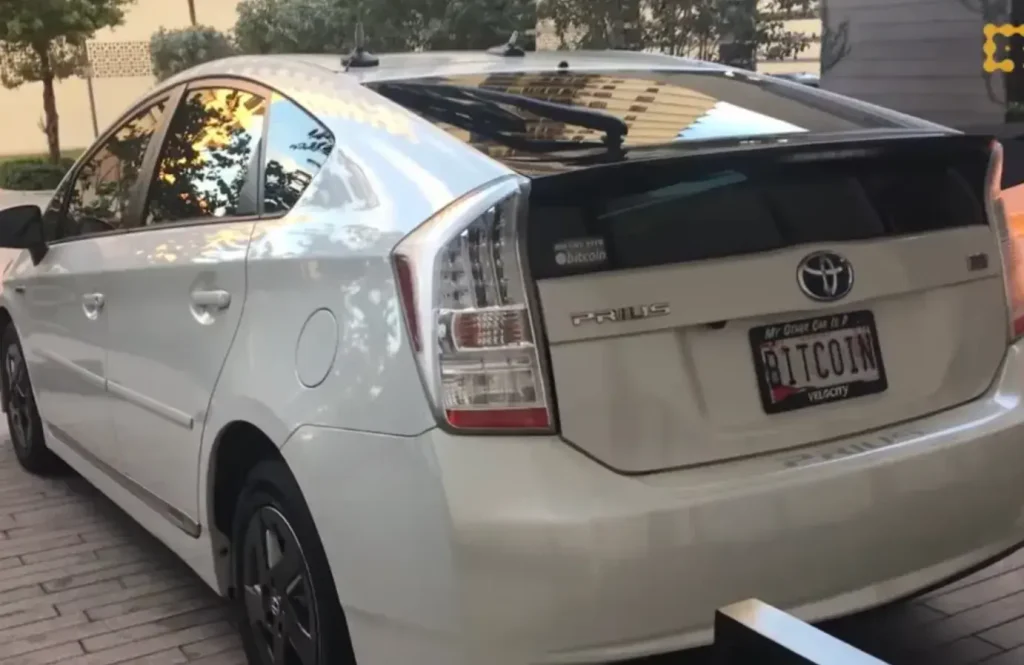
The Toyota Prius Bitcoin story didn’t end at the lot. The car itself became a roving museum piece. It hit over 30 Bitcoin events, ferried hundreds of thousands of dollars in cash from early BTC ATMs, picked up signatures from a who ‘s-who of crypto developers, and survived a 2021 crash that nearly totalled it. After full restoration, the Prius went back on the road for a final tour.
The Bitcoin car auction finale happened at Bitcoin 2023 in Miami, where the Prius rolled across the block one last time. Final hammer price: 1.2 BTC. The car ended up costing less than its own legend by a comfortable margin, which feels right for a piece of crypto archaeology that started its life as a daily driver in 2013.
What makes the Prius story durable isn’t the price tag, then or now. It’s the proof that you could replace cash, financing, dealer paperwork, and the entire payment chain with a single on-chain transaction. The 2013 sale didn’t involve a payment processor, a lien check, or a wire transfer from a third-party escrow. The car changed hands the same week the funds were confirmed.
Cars get bought with Bitcoin regularly now. Tesla briefly accepted it for the Model 3 in 2021, Lamborghini dealers in Miami advertise crypto checkout, and several used-car platforms route payments through stablecoins. The 2013 Prius is the receipt that started the chain.
A BTC Space Ticket
In November 2013, Virgin Galactic announced it would accept BTC for sub-orbital flights at $250,000 a seat. The first taker was a flight attendant from Hawaii who paid the full fare in coins. The Virgin Galactic Bitcoin payment came in at exactly 350 BTC. Richard Branson Bitcoin comments followed shortly after on CNBC, where he personally welcomed her onto the future passenger manifest and called Bitcoin “a new exciting currency.”
Those 350 BTC at 2026 prices would clear roughly $35 million, depending on the day.
The BTC space ticket itself is still pending. Virgin Galactic’s regular commercial service only began years later, and the early bitcoin buyers are spread across a manifest that has been rescheduled more times than anyone has cared to count.
This sits as the most expensive frequent-flyer commitment in crypto history, paid in advance.
What makes the Virgin transaction interesting in retrospect isn’t the appreciation, though that part lands hard. Is it that a luxury aerospace company in 2013 was willing to take payment in something most of its own auditors hadn’t heard of? Branson’s bet was that bitcoin would graduate from curiosity to actual currency. It did, though the path took longer than the press release suggested.
The flight attendant has not publicly commented on whether she still holds any portion of her original wallet, what she did with the rest, or whether she’s still waiting on the launch slot. That detail, like most details about early bitcoin holders, has aged into folklore. The space ticket may yet be honored. The coins, in any case, have long since paid for themselves several times over.
What Has Changed
Five strange receipts, all from a market that wasn’t supposed to work. None of them looked historic at the time. Each one quietly proved a different point: that BTC could buy a meal, ship physical goods across state lines, route around sanctions, replace cash at a car dealership, and pre-book a seat on a rocket. The network grew by expanding into new categories, one transaction at a time.
The pattern matters because it reframes how you read what can you buy with Bitcoin today. The answer in 2026 is “almost anything you’d buy with a card, plus a few categories cards still don’t reach.” That breadth wasn’t designed top-down. It accreted from individual experiments, most of which looked silly in their own moment.
SimpleSwap has watched that growth from the infrastructure side, routing swaps since 2018 through bear markets, bull runs, the rise of institutional desks, and the launch of spot ETFs. Across 2,800+ assets and 20+ liquidity providers, the system picks the route under the hood so users don’t have to compare rates by hand.
Your next “historic transaction” doesn’t have to be the kind you tell with regret. Whether you’re rebalancing a portfolio, moving capital between chains, or just curious what kind of receipt you might leave behind in 2036, the rails are quieter than they were in 2010. Worth using them while the prices still surprise you.
Bitcoin real-world payments FAQ
What could you buy with Bitcoin in 2010?
How much would 350 BTC be worth today?
Can you buy a car with Bitcoin today?
What is Bitcoin censorship resistance?
What was Satoshi Nakamoto's last message?
The information in this article is not a piece of financial advice or any other advice of any kind. The reader should be aware of the risks involved in trading cryptocurrencies and make their own informed decisions. SimpleSwap is not responsible for any losses incurred due to such risks. For details, please see our Terms of Service.