


USDT to XMR: A Bridge Between Transparency and Privacy

Updated: Oct 6, 2026

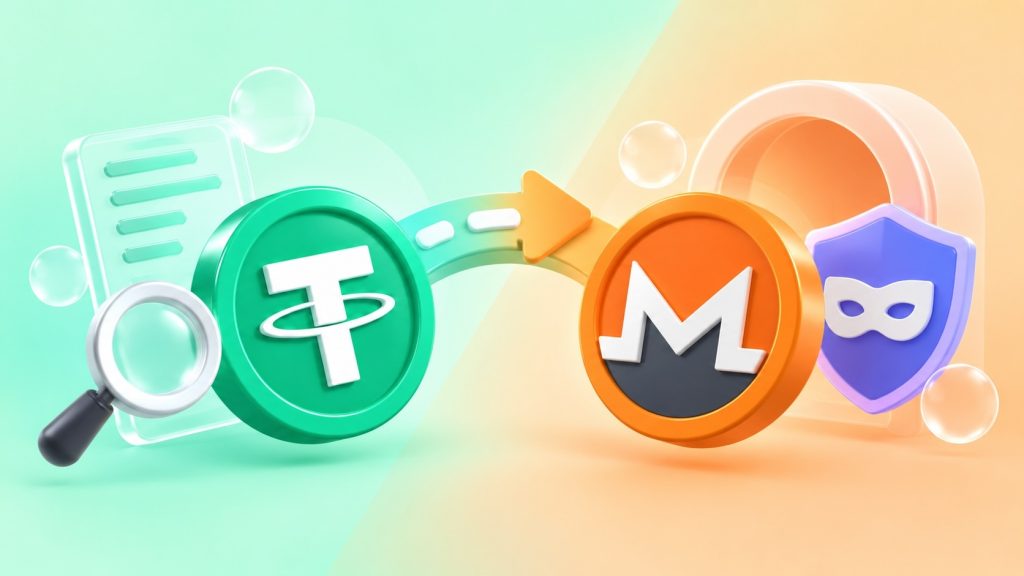
Tether’s USDT runs on blockchains where every balance and transfer is public. Monero’s XMR runs on one where amounts, senders, and recipients are hidden by default. Moving between them is a common swap with an unusual property: the two sides of the trade obey different rules about what the world can see. Here is why people do it, how it works, and what the transparent half of the trade still tells you.
To convert USDT to XMR, you use a swap service that accepts USDT on your network and pays out Monero to a Monero address you control. The USDT leg is recorded publicly on TRON, Ethereum, or wherever your USDT lives. The XMR leg lands on Monero, where the amount and recipient aren’t publicly visible on-chain. People do this for the same reasons they use cash or a private bank account: to keep salaries, savings, and purchases from being readable by anyone with a block explorer. Swap services still apply compliance screening to the USDT they receive, and Monero is not available on every platform or in every jurisdiction.
What Monero hides, and what it does not
Monero (XMR) launched in April 2014. Its privacy is built into the protocol rather than added as an option.
| Property | Bitcoin, Ethereum, TRON | Monero |
| Sender visible on-chain | Yes | Obscured by ring signatures (the true sender is one of a set of possible signers) |
| Recipient visible on-chain | Yes | Hidden by stealth addresses (a one-time address per payment) |
| Amount visible on-chain | Yes | Hidden by RingCT (confidential transactions, since 2017) |
| Address reuse reveals history | Yes | No; each payment goes to a unique one-time address |
| Block time | 12 s (ETH), 3 s (TRON), 10 min (BTC) | About 2 minutes |
| Confirmations exchanges typically wait for | Varies | Around 10 (roughly 20 minutes) |
| Supply schedule | Varies | Tail emission of 0.6 XMR per block since mid-2022 |
What Monero does not hide: the fact that a transaction occurred, the approximate time, and anything you reveal off-chain. If you post your address publicly or send XMR to an exchange account in your name, the protocol’s privacy does not extend to those facts. Monero’s own documentation describes the properties above as privacy, not as untraceability, and that is the right word.
Why convert a transparent asset into a private one
The question sounds pointed only because crypto normalized total transparency. Ask it about a bank statement and the answers are obvious.
Salary and income privacy. A freelancer paid in USDT has a public ledger of every client and the amount paid, readable by the next client, a competitor, or a landlord. Converting to XMR closes that ledger going forward.
Savings that are not a target. A wallet holding a visible six-figure USDT balance is a target for phishing, address poisoning, and, in some places, physical threats. A Monero balance is not readable.
Commercial confidentiality. A business paying suppliers in a transparent stablecoin discloses its supplier list, volumes, and margins to anyone who traces the address. That is information companies protect under ordinary confidentiality law.
Payments to people who should not see each other. A charity paying local partners, a journalist paying sources, a person supporting a family member in a difficult jurisdiction. Transparent chains connect all of them to each other.
Financial privacy as a default, not a signal. Privacy is legal in most jurisdictions, and using it is not an indication of anything. Cash works the same way.
None of these uses requires hiding from a regulator, and none of them is served by a service that ignores compliance. The value is in the on-chain record, which after the swap no longer broadcasts your affairs to the public.
Where Monero is and is not available
Monero has been delisted from several major centralised exchanges since 2024, including Binance and, for EEA customers, Kraken and others, largely in response to EU anti-money-laundering rules that make privacy-coin support difficult for regulated venues. It remains available on some exchanges, on decentralised venues and through self-custodial swap services.
Availability also depends on where you are. Some jurisdictions restrict privacy coins outright. A swap service operating under its own terms of use may not serve users in certain countries. Check before you plan around it.
How a USDT to XMR swap works technically
- You provide a Monero address. Standard Monero addresses are 95 characters and start with 4; subaddresses start with 8. Use one generated by your own Monero wallet.
- The service quotes a rate. A fixed rate holds for a set window; a floating rate settles at execution. XMR’s price moves like any other asset, so the choice matters.
- You send USDT to a deposit address. This transaction is public on the USDT network. The service’s compliance screening runs on it, and a swap may be paused for review if the screening requires it.
- The service sources XMR from its liquidity providers and sends it to your Monero address.
- You wait for Monero confirmations. Your wallet shows the incoming payment after the first block and treats it as spendable after 10.
The public record shows USDT leaving your address and arriving at the service. On Monero, the transaction is recorded, but the sender, recipient and amount are not publicly exposed in directly readable form, so the public record does not link the XMR payout to your USDT deposit by amount or destination.
Before you swap: a short checklist
- Use your own Monero wallet. The official Monero GUI and CLI, Feather, Cake Wallet and Monerujo are widely used. Downloading from anywhere other than the project’s official sources is how wallets get compromised.
- Sync the wallet first. A Monero wallet needs to scan the chain to show a balance. A fresh wallet can take time to sync; a remote node speeds this up at the cost of some privacy.
- Verify the address. Copy from your own wallet, compare the start and end, and never accept an address someone else supplies as “yours.”
- Understand the entry side is public. Everything about the USDT you send is visible. If the USDT has a history you did not create, screening may flag it.
- Do not confuse privacy with protection. Monero hides transaction details. It does not recover funds sent to the wrong address, protect a seed phrase, or make a scam refundable. The attacks that do reach Monero users, fake wallets and fake support above all, are covered in SimpleSwap’s Safety Academy.
Converting USDT to XMR with SimpleSwap
SimpleSwap is a self-custodial swap aggregator that has listed Monero alongside 2,800+ other assets. To swap USDT for XMR:
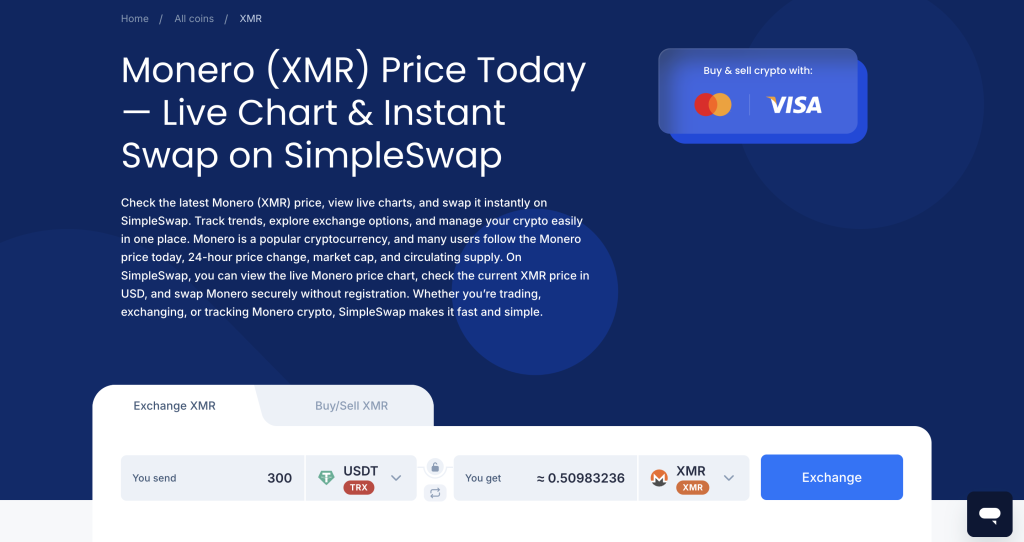
- Select USDT as the asset to send and XMR as the asset to receive.
- Choose a fixed rate to lock the quote for 20 minutes, or a floating rate.
- Paste your Monero address and confirm.
- Send USDT to the deposit address generated for your order.
- XMR arrives in your wallet after Monero confirmations. Track the order by its ID.
No account is required to complete a crypto-to-crypto swap. SimpleSwap holds no long-term user balances, and the rate shown includes a 0.2% fee. SimpleSwap applies risk-based transaction screening, and a swap may be paused for additional review where legal or compliance obligations require it; a pause is not an accusation, and support will explain what is needed to move the case forward.
Availability is subject to SimpleSwap’s Terms of Use, including jurisdictional restrictions. The only official domain is simpleswap.io.
FAQ: how to convert USDT to XMR
How do I convert USDT to XMR?
Is it legal to convert USDT to Monero?
Is Monero untraceable?
Why would someone convert stablecoins to Monero?
How long does a USDT-to-XMR swap take?
How long does a USDT-to-XMR swap take?
Can I buy Monero on Binance or Kraken?
Does the swap service see my Monero balance?
The information in this article is not a piece of financial advice or any other advice of any kind. The reader should be aware of the risks involved in trading cryptocurrencies and make their own informed decisions. SimpleSwap is not responsible for any losses incurred due to such risks. For details, please see our Terms of Service.