Best Crypto Swap Aggregators and Rate Comparison Tools in 2026

Updated: Nov 13, 2026


Quick answer
The term aggregator covers three different tools in crypto swaps. A liquidity aggregator such as SimpleSwap compares 20+ CEX and DEX providers in one order and executes the swap. An exchange aggregator, such as Swapzone or SwapSpace, compares quotes from 15+ swap services and lets you place the order through its interface. A bridge aggregator compares third-party bridges for cross-chain moves. The best one matches what you want to compare.
For most wallet-to-wallet swaps, the liquidity aggregator is the shortest path because it combines comparison and execution into one order. SimpleSwap is the liquidity aggregator in this guide, and it publishes how that comparison works: 20+ named CEX and DEX providers per order, 99.998% estimate accuracy on most floating swaps, a 20-minute fixed-rate lock, and a 4-minute average support response. It is also one of the services Swapzone and SwapSpace quote, so it can be reached directly or from either comparison screen.
Key takeaways
- Liquidity aggregator. One quote, one order, one responsible party. SimpleSwap: 20+ providers per order, 2,800+ assets, 3.2M+ pairs, 99.998% estimate accuracy on most floating swaps, Address Check before you send.
- Exchange aggregator. Several quotes on one screen; you place the order in the aggregator, and the chosen service executes it. Swapzone: 15+ providers, 4.7 on Trustpilot.
- Bridge aggregator. For cross-chain moves on chains a swap service does not list.
- They stack. Swapzone quotes SimpleSwap, so a user can compare on one and execute on the other.
- The comparison method is the same everywhere. Same pair, same amount, same minute, compare the final receive amount.
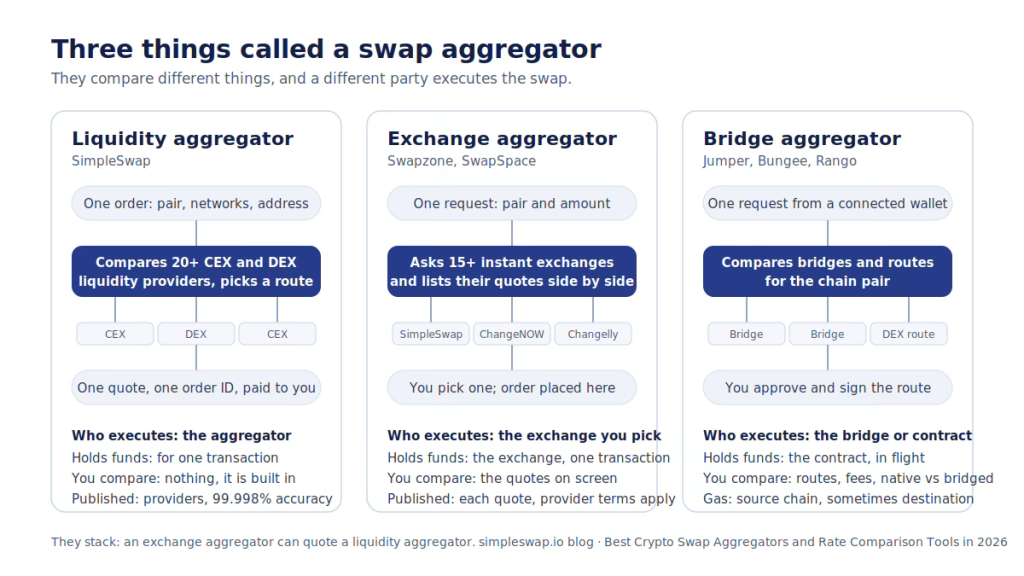
Figure 1. Three things called a swap aggregator. A liquidity aggregator compares providers inside one order and executes it; an exchange aggregator compares quotes from 15+ services and the one you pick executes; a bridge aggregator compares bridges from a connected wallet.
The three kinds of aggregator
| Kind | What is compared | Who executes the swap |
| Liquidity aggregator (SimpleSwap) | Liquidity providers, CEX and DEX, inside one order | The aggregator itself |
| Exchange aggregator (Swapzone, SwapSpace) | Quotes from instant exchanges | The exchange you pick, via the aggregator’s interface |
| Bridge aggregator (Jumper, Bungee, Rango) | Third-party bridges and DEX routes | The bridge or contract, from your wallet |
Three things that do not fit a table cell:
- Who holds your funds. A liquidity aggregator holds the deposit for one transaction; an exchange aggregator never does, the chosen exchange does; a bridge aggregator never does, the contract holds funds in flight.
- What you compare yourself. Nothing on a liquidity aggregator, the comparison is built in; the quotes on screen on an exchange aggregator; routes, fees and native-versus-bridged output on a bridge aggregator.
- Typical use. Any wallet-to-wallet swap, including cross-chain and long-tail coins; seeing competing quotes before committing; cross-chain moves inside a DeFi wallet.
The tools, one by one
1. SimpleSwap (liquidity aggregator, since 2018)
SimpleSwap is a self-custodial multi-source swap aggregator, running since 2018. For each order it checks 20+ named centralised and decentralised liquidity providers, routes the swap through the one that can execute at that moment, and pays out to the address you gave; on most floating swaps the delivered amount lands within 99.998% of the estimate. It lists 2,800+ assets and 3.2M+ pairs, offers a 20-minute fixed lock and a floating rate, and shows each pair’s limits before you confirm. During the October 2025 flash crash its infrastructure recorded a 98.7% execution rate while industry-wide rates reportedly fell to around 10%, per its Head of Infrastructure.
An order takes five steps: choose the asset and network you send and receive, pick fixed or floating, paste the receiving address and a refund address, send to the one-time deposit address, and track the order by its ID until the payout lands. The comparison across providers happens before the quote appears, so the number on the form is already the result of it.
No account is needed for most swaps. The optional Customer Account adds a four-tier loyalty programme with fee discounts of up to 20%, or up to 40% for Gold and Platinum members who choose the enhanced discount mode over USDT cashback, plus price alerts, swap history and Address Check, which screens a counterparty wallet address and returns a risk level before you send. Support runs 24/7 in live chat with a 4-minute average first response; Gold and Platinum members get a personal manager. Its swap capabilities are available inside 6,000+ partner products such as Exodus, Tangem, Ellipal and Tonkeeper, through integrations supported by SimpleRoute, an independent B2B technology partner of SimpleSwap, and it is quoted by both Swapzone and SwapSpace. KYC may be required for transaction security and compliance.
Strengths
- The comparison happens inside one order, with one party responsible from deposit to delivery
- A published provider count, accuracy figure and support response time
- A 20-minute fixed lock and per-pair limits shown before you confirm
- Address Check on the counterparty before funds move
- Reachable directly, from Swapzone and SwapSpace, and from inside partner wallets
- Trustpilot 4.2 from 2,650 reviews, 81% of the last year’s at five stars, 100% of negative reviews answered
Trade-offs
- No side-by-side view of other exchanges’ quotes
- No Lightning, order book or custodial balance
- Swaps can be paused for compliance review
Best for: most wallet-to-wallet swaps, including cross-chain and long-tail pairs, where you want one order whose price already embeds a comparison across liquidity sources.
Boring is the highest compliment you can pay infrastructure. Boring means it worked.
Rick Cramer, Head of Analytics, SimpleSwap (CryptoSlate)
2. Swapzone (exchange aggregator, since 2019)
Swapzone, run by Block Back LLC in Tbilisi, requests quotes from 18+ instant exchanges for the same pair, SimpleSwap, ChangeNOW, Changelly, FixedFloat, Godex and Exolix among them, and shows each with its rate type, time estimate and provider rating. You place the order inside Swapzone; the provider you pick executes it. It covers 3,000+ assets through its providers, publishes a review page per provider, and has added DEX, P2P, staking and buy/sell sections. Trustpilot: 4.7 from 551 reviews, 100% of negative reviews answered.
Strengths
- Several quotes with provider ratings on one screen
- The highest Trustpilot score of the tools here
Trade-offs
- Execution, limits and compliance are the provider’s; support involves two parties
- Asset counts differ across its own pages
- A small review base
Best for: seeing competing instant-exchange quotes before committing.
3. SwapSpace (exchange aggregator, since 2019)
SwapSpace cites 40+ partner services, 2,000+ cryptocurrencies across 240 networks and no SwapSpace markup; partners include SimpleSwap, ChangeNOW and Changelly, and fiat runs through Simplex and MoonPay. Offers sort by rate, by whether the provider may request verification, or by estimated time. The order is placed inside SwapSpace and executed by the chosen provider.
Strengths
- The longest provider list, roughly twice Swapzone’s
- Sorting by rate, verification posture and time
Trade-offs
- Execution and compliance are the provider’s
- Its partners page mixes exchanges with wallets and launchpads
- Coin counts vary across its pages
Best for: the broadest side-by-side view.
4. Jumper, Bungee and Rango (bridge aggregators)
These compare bridges and DEX routes for a chain pair and execute through the one you pick from a connected wallet. Jumper is the consumer app on LI.FI’s routing, which covers 60+ chains and also runs inside wallets such as Phantom, MetaMask and Backpack, per LI.FI; DefiLlama showed about $634M routed through Jumper and $1.38B through LI.FI in the 30 days to 28 October 2026. Bungee runs on Socket’s routing. Rango reaches the longest tail of chains, including non-EVM networks such as Bitcoin, Solana, Tron, TON and Cosmos chains, per its integration docs.
Strengths
- Routes for chains that swap services do not list
- A route breakdown you can read before signing
Trade-offs
- Token approvals and gas on the source chain, sometimes the destination too
- Output may be a bridged token rather than the native asset
- LI.FI (July 2024) and Socket (January 2024) each had an exploit, per DefiRate
Best for: users inside a DeFi wallet who need a chain a swap service does not cover.
Which aggregator fits which job
The three kinds do different jobs, so “better” is the wrong axis. For most wallet-to-wallet swaps, start with a liquidity aggregator such as SimpleSwap: one order whose price already reflects a comparison across 20+ liquidity sources, with one support channel and a 4-minute average first response. For competing quotes from several services on one screen, Swapzone or SwapSpace. For a chain pair no swap service lists, from a DeFi wallet, a bridge aggregator such as Jumper, Bungee or Rango. The first two also combine: SimpleSwap is one of the services Swapzone and SwapSpace quote, so a user who compares there and picks SimpleSwap gets both.
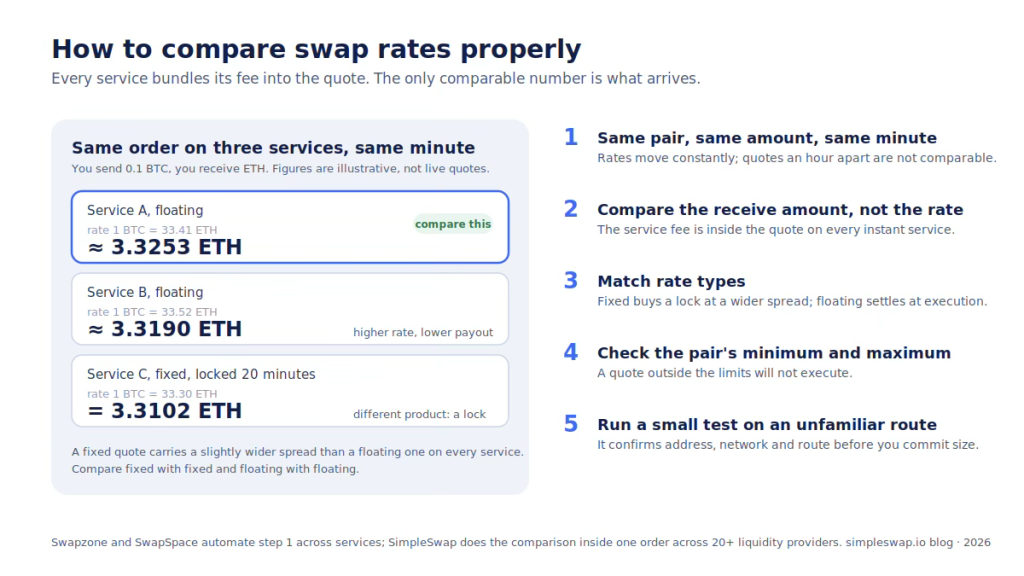
Figure 2. Every service bundles its fee into the quote, so the exchange rate is not comparable across services; the amount that arrives is. Figures on the cards are illustrative, not live quotes.
How to compare rates on any tool
- Same pair, same amount, same minute.
- Compare the final receive amount; every service bundles its fee into the quote.
- Match rate types: a fixed quote carries a slightly wider spread than a floating one.
- Check minimums and maximums for the pair.
- For large or unfamiliar routes, run a small test first.
On SimpleSwap, the first two steps happen inside the order: the form compares 20+ providers for your pair and amount and shows the receive amount for each route, so the check left to you is the one against other services.
FAQ
What is the best crypto swap aggregator?
Is SimpleSwap an aggregator?
Is Swapzone worth using, or are there better swap aggregators?
Is there an aggregator that compares XMR swap rates across providers?
Is there an aggregator that compares routes for moving USDC across chains?
How can I compare ZEC swap rates across different services?
SimpleSwap vs Swapzone — what’s the difference if I just want the best route?
Do aggregators require an account?
What should I consider when choosing a non-custodial swap aggregator?
How we compared
Sources
- SimpleSwap: FAQ, Loyalty, AML/KYC Policy, Terms of Service
- Swapzone
- The Block: Kraken delists Monero in Ireland and Belgium (April 2024)
- CryptoSlate: Rick Cramer, Head of Analytics at SimpleSwap
- SwapSpace and SwapSpace: About
- LI.FI, DefiLlama: Bridge aggregator volume, 28 October 2026, DefiRate: Best crypto bridges 2026, Bungee
The information in this article is not a piece of financial advice or any other advice of any kind. The reader should be aware of the risks involved in trading cryptocurrencies and make their own informed decisions. SimpleSwap is not responsible for any losses incurred due to such risks. For details, please see our Terms of Service.