Ways to Move Stablecoins Across Chains Without a CEX in 2026

Updated: Nov 6, 2026


Last updated: 6 November 2026.
Quick answer
You can move USDC or USDT across supported chains without opening a centralised exchange account. The options below include wallet-to-wallet swap services, Circle’s CCTP for native USDC, the USDT0 network, bridge aggregators, canonical bridges and wallet interfaces. These categories overlap: a wallet or aggregator may use CCTP or USDT0 underneath. A swap order can reduce the steps you perform, but still exposes your deposit to a service and its execution partners while it is processed. Check the destination chain, exact token contract, fees and recovery process before sending.
Key takeaways
- Swap order. Choose the sending and receiving assets and networks, provide a receiving address and send the deposit. Availability, quotes and completion estimates change; no particular completion time is guaranteed.
- CCTP for USDC. Circle’s CCTP burns USDC on one chain and mints native USDC on another. How many transactions you sign and who pays destination gas depend on the app built on it.
- USDT0 for USDT. The core OFT mechanism locks USDT on Ethereum and mints USDT0 on a supported destination, or burns and mints between compatible USDT0 deployments. Legacy Mesh routes also connect native USDT on networks such as Tron and Solana, using a different, liquidity-based path. Arbitrum’s existing USDT contract was upgraded in place in early 2025.
- Bridges and routers. Aggregators and wallet interfaces expose different subsets of routes. The output can be native USDC or a bridged representation such as USDC.e; a familiar ticker is not enough to identify it.
- The token is the whole game. USDC and USDT exist on many chains and in several versions; the receiving network must match the receiving address, and the receiving token must be the one your app expects.
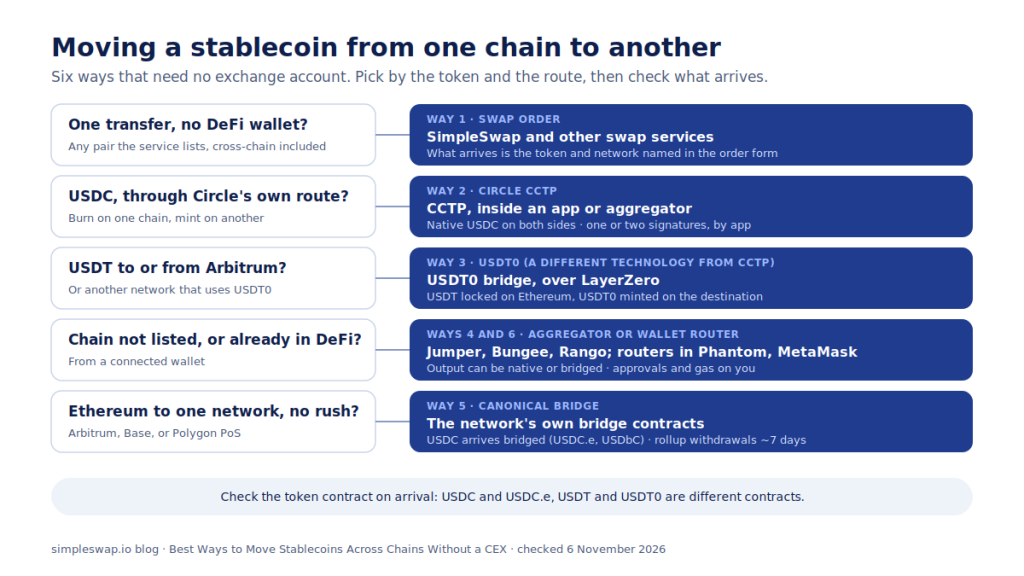
Figure 1. Six ways to move a stablecoin across chains without opening a CEX account. Diagram qualification: CCTP can require approve, burn and mint transactions, with the mint potentially submitted by a relayer. USDT0 also connects native-USDT chains through Legacy Mesh. On Arbitrum the old USDT contract was upgraded in place to USDT0; a new ticker did not mean a new address.
The six ways compared
The first table compares wallet actions and gas responsibilities; the second compares the assets received. Counts are indicative: approvals, permits, relayers and account abstraction can change the number of prompts.
What you sign and what you pay
| Way | What you sign | Gas you pay |
|---|---|---|
| Swap order such as SimpleSwap | Usually one deposit transfer | Source transfer; payout costs reflected in offer |
| Circle CCTP for USDC | Burn; approval if needed; mint by you or relayer | Source gas; destination directly or via relayer |
| USDT0 network | Transfer; approval if needed | Gas and messaging; Legacy Mesh fee where used |
| Bridge aggregator | Route transactions; approvals if needed | Source; destination or relayer depending on route |
| Canonical bridge | Deposit; approval if needed; withdrawal proof/claim | Source, plus destination claim/proof where needed |
| Wallet router | Depends on route and existing allowances | Wallet/app route determines gas and fees |
What you get
| Way | What arrives | Fits best when |
|---|---|---|
| Swap order | Contract specified or confirmed for that order | Deposit-and-payout workflow is preferred |
| Circle CCTP for USDC | Native USDC | Supported native-USDC transfer |
| USDT0 network | USDT0 or native USDT, depending on route | Destination app accepts the exact output token |
| Bridge aggregator | Native or bridged token, depending on route | Compare available bridge and swap routes |
| Canonical USDC bridge | USDC.e on Arbitrum/Polygon PoS; USDbC on Base | Destination accepts that bridged representation |
| Wallet router | Depends on enabled route | Use routing within an existing wallet |
These workflows can avoid a CEX account for the user. That does not mean that no centralised provider is involved: swap services may use CEX liquidity, and apps may apply geographic restrictions, screening or verification requirements.
The ways, one by one
1. A wallet-to-wallet swap order on SimpleSwap
SimpleSwap is a wallet-to-wallet swap service that describes itself as a self-custodial multi-source aggregator. You select the sending and receiving assets and networks, enter the receiving address and transfer the deposit to the address provided for that order. Its FAQ says it aggregates 20+ CEX and DEX providers; this is a company-reported figure, not an independently audited coverage measure. Most crypto-to-crypto swaps do not require registration. The optional Customer Account offers service-fee discounts and other features. The FAQ describes an all-in exchange rate with a dynamic fee that may start from 0.2% for some assets; this is not a guaranteed fee for a particular stablecoin pair. Floating-rate output can change. Support is advertised as available 24/7, but no response-time guarantee is assumed here. Screening or KYC can delay or stop an order, and the Terms allow funds to be frozen in specified circumstances.
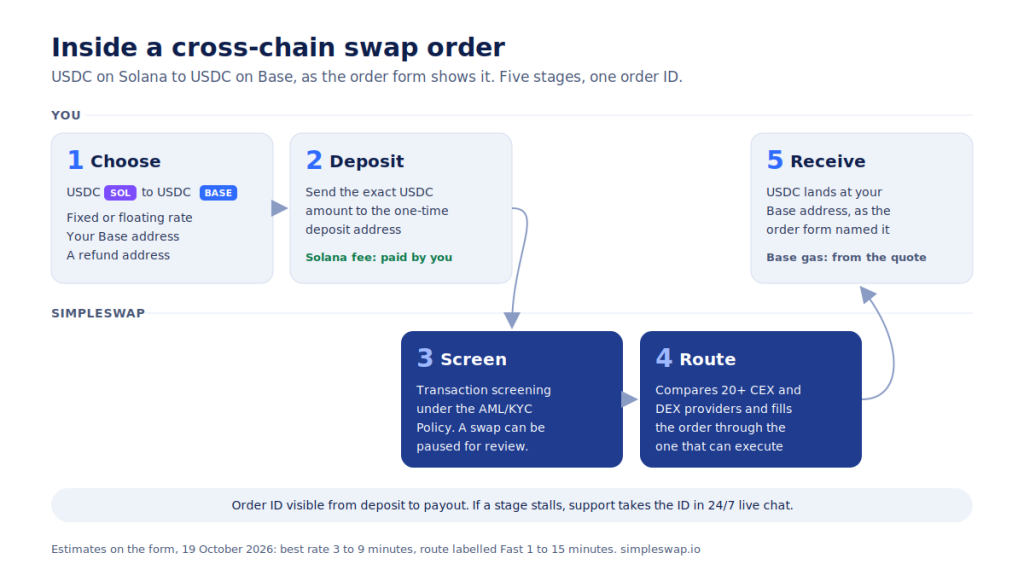
Figure 2. A deposit-based cross-chain swap workflow. The user pays the sending-chain fee; payout costs are reflected in the offer. The illustration’s timing labels are historical examples supplied in the original artwork, not a verified live quote or a completion guarantee. Provider coverage is a company-reported figure. Screening can interrupt processing; refunds follow the Terms.
ChangeNOW, Changelly and StealthEX also offer crypto swap services. Check each service’s live token and network listings, total receive amount, verification policy and refund terms before using a stablecoin pair; their fees, routes and processing times are not interchangeable.
Strengths
- For a standard deposit-based swap: one outgoing wallet transfer, without a DeFi token approval; receiving-side payout costs are reflected in the offer.
- The service handles execution after the deposit. Do not assume a specific bridge or settlement venue unless the order discloses it.
- Can be funded from a compatible self-custodial wallet, including a hardware wallet. Exchange withdrawals may work if they meet the order’s network, amount, memo and timing requirements; the sender then uses an exchange account.
- An Exchange ID for status tracking and access to support.
Trade-offs
- The ticker and network alone may not identify the token contract. Verify the exact output contract before funding; ask support if the order form does not disclose enough information.
- No ongoing exchange balance is required, but you lose unilateral control of the deposit while it is processed. Execution, counterparty and compliance risks remain; refunds are subject to the Terms.
- The all-in quote includes service and execution costs. CCTP-based alternatives can also have gas, app, forwarding or Fast Transfer charges; compare the complete cost rather than assuming an issuer route is free.
Best for: users who prefer a deposit-and-payout workflow and accept the service’s execution and compliance terms.
The argument about who holds your money is won. The one about how you move it is still open. SimpleSwap has spent eight years on the second argument while keeping the first intact.
Stefan Lauer, Head of Infrastructure, SimpleSwap (CryptoSlate)
2. Circle CCTP, for USDC
Circle’s Cross-Chain Transfer Protocol burns USDC on the source chain, uses Circle’s attestation service to verify the burn and mints native USDC on the destination. This avoids a traditional bridge liquidity pool and a wrapped USDC representation, but still depends on Circle, its contracts and attestation infrastructure. Ethereum, Solana, Base, Arbitrum and Polygon PoS are supported USDC routes. Check the current token-specific list: a chain’s presence in CCTP does not mean every token is supported there. A direct EVM flow can require an approval, a burn and a destination mint transaction. Apps or forwarding services may submit the mint for you.
Strengths
- Native USDC on both sides, issued by Circle itself
- No traditional bridge liquidity pool is needed for USDC settlement; per-message limits, Fast Transfer allowances and operational availability still apply.
- Available through compatible apps and aggregators; each interface can expose fewer routes than the protocol itself.
Trade-offs
- The USDC transfer mechanism does not transfer native USDT. Circle separately documents CCTP for non-USDC assets, including EURC and configured ERC-20 assets; its token and wrapping rules must be checked separately.
- A connected wallet; EVM approval if needed, then a burn, and a destination mint submitted by you or a relayer. Signature and transaction counts vary by chain and app.
- Waiting for Circle’s attestation and destination execution. Standard and Fast Transfer have different timing and fee conditions; app or forwarding fees can also apply.
Best for: supported USDC routes where receiving Circle-issued native USDC is the priority; check route limits for large transfers.
3. USDT0, for USDT
USDT0 extends USDT across supported networks using LayerZero’s Omnichain Fungible Token standard. In the core lock-and-mint route, USDT is held in an Ethereum adapter and a corresponding amount of USDT0 is minted on the destination. Between compatible OFT deployments, USDT0 is burned on the source and minted on the destination. The docs describe 1:1 backing; this is a design and backing claim, not a guarantee against contract or verifier failure. Legacy Mesh additionally links existing native USDT deployments, including Tron, TON, Solana and Celo, through liquidity pools and an Arbitrum hub. Not every deployment is directly connected to every other one.
Strengths
- A unified USDT0 representation across compatible deployments, reducing the need for separate bridge-specific versions.
- The OFT route avoids the standard optimistic-rollup withdrawal wait; actual completion still depends on chain confirmations, message verification and execution.
- Arbitrum’s USDT was upgraded to USDT0 in early 2025 without changing its token contract address or requiring holders to migrate manually. The official USDT0 app supports transfers to Arbitrum; the legacy gateway should not be used.
Trade-offs
- Additional contract, administrator and cross-chain verification risks on top of Tether issuer risk. The LayerZero/OFT mechanism and its configured verifiers are separate from the destination rollup’s canonical bridge security.
- OFT deployments and Legacy Mesh routes differ. Native USDT on Tron or Solana remains a different deployment; it can still connect through Legacy Mesh. Confirm the route and output contract rather than assuming every USDT label means USDT0.
- An approval may be needed on EVM chains, plus a transfer transaction and gas/messaging costs. The docs state a 0.03% fee for Legacy Mesh transfers, distinct from the core OFT route’s protocol fee policy; use the live quote for the total.
Best for: supported USDT and USDT0 routes where the receiving app accepts the exact destination token.
4. Bridge aggregators such as Jumper Bungee and Rango
Bridge and swap aggregators compare available routes for a chain pair and amount. Jumper uses LI.FI; Bungee is built by the team behind Socket; Rango documents EVM and non-EVM integrations including Bitcoin, Solana, Tron, TON and Cosmos networks. An integration listing does not guarantee a live stablecoin route for every pair. Check the actual offer, underlying bridge, output contract, fees and approval target before signing. No comparable live route test or volume ranking is claimed here.
Strengths
- Route and cost information before confirmation; check whether the displayed path uses CCTP, USDT0, a liquidity bridge or another mechanism.
- A range of chains and route combinations; coverage must be checked for the specific token and direction.
Trade-offs
- Approvals or permits where required, source-chain execution costs, and possibly destination gas or relayer charges.
- Output may be a bridged token such as USDC.e rather than the native version
- Approval and integration vulnerabilities remain possible. LI.FI’s own report describes a July 2024 exploit affecting wallets with unlimited approvals to the vulnerable contract. Limit approvals to what is needed and review the current route’s security.
Best for: users comfortable reviewing a DeFi route and its approvals, particularly when comparing several bridges.
5. Canonical bridges for Arbitrum Base and Polygon PoS
Arbitrum One and Base use Ethereum rollup bridge contracts. Ethereum deposits and withdrawals have different finality paths; standard withdrawals to Ethereum involve a challenge/finalization window, generally around seven days, plus the required proof or claim steps. Check the network’s current instructions rather than treating seven days as an exact deadline. Base’s former bridge.base.org interface is deprecated; its docs point users to interfaces including Superbridge and Brid.gg, which can also expose non-canonical routes. Polygon PoS is not an optimistic rollup: its PoS bridge uses checkpoints and a separate Ethereum exit transaction.
For Ethereum-origin USDC sent through the traditional canonical token bridges, the representations are USDC.e on Arbitrum One and Polygon PoS, and USDbC on Base. These differ from Circle-issued native USDC. CCTP is one way to receive native USDC on those networks; other routes may also deliver native USDC from destination liquidity. A bridge website may offer several mechanisms, so identify the selected route. For Arbitrum USDT, use a supported USDT0 route rather than the legacy gateway.
Strengths
- Use the network’s canonical bridge contracts rather than a third-party liquidity bridge, subject to that network’s own security and administrative assumptions.
- Can suit supported Ethereum-origin assets when the canonical representation is accepted by the receiving app.
Trade-offs
- Traditional canonical USDC deposits produce a bridged representation; legacy Arbitrum USDT is not the appropriate route.
- Gas on the sending chain and, for withdrawals, additional proof/claim transactions and destination-chain gas. Standard rollup withdrawal windows or Polygon checkpoint processing add waiting time.
- The Ethereum-to-network canonical routes described here do not provide a direct Solana-to-Base native-USDC transfer. Other bridges may connect those ecosystems.
Best for: supported Ethereum-to-network transfers where the canonical token representation and withdrawal process meet your needs.
6. Routers inside wallets such as Phantom MetaMask and Backpack
Wallets can integrate external routing infrastructure. LI.FI names Phantom, MetaMask, Backpack, Robinhood Wallet and OneKey among wallets using its Solana swap and bridging capabilities. This does not mean every wallet exposes all LI.FI chains, every route or the same fees. Verify the current wallet-specific offer and receiving token.
Strengths
- No separate site; the route and the wallet are one screen
- Access to the routes enabled by that wallet and integration; this may be a subset of the aggregator’s coverage.
Trade-offs
- Tied to that wallet and that aggregator’s chains
- Approvals where required, gas or relayer costs, and any wallet or app fees shown in the quote.
Best for: users who already keep their stablecoins in one of these wallets.
Common routes
I’ve got USDC on Solana and need it on Base. What’s the easiest way to move it?
A deposit-based USDC-on-Solana to USDC-on-Base swap can be convenient if the service currently lists that pair. Verify that the output is native USDC on Base, enter your Base receiving address and follow the live deposit instructions. CCTP also supports a native-USDC transfer from Solana to Base through compatible apps. Ease and speed depend on the interface, wallet and current route; no fixed 3–9 or 1–15 minute outcome is promised.
What’s the cheapest way to move USDC from Solana to Ethereum?
There is no universally cheapest route. Compare quotes for the same input amount and include the Solana sending fee, Ethereum mint/payout gas, and any service, protocol, forwarding or app fee. For a swap service, distinguish the estimated receive amount from the costs paid separately by your sending wallet; a floating quote may change. For CCTP, check whether destination execution is paid directly or through a relayer. Compare total cost and the exact output token.
What’s the best way to bridge USDT from Ethereum to Arbitrum?
USDT0 is the supported USDT transfer system described by the official Arbitrum USDT0 page. The existing Arbitrum USDT contract was upgraded in place; the official address is 0xFd086bC7CD5C481DCC9C85ebE478A1C0b69FCbb9. You can use the official transfer app linked from usdt0.to or a verified route using that system. A swap service may also offer USDT on Arbitrum; confirm the output contract before sending. Do not infer the contract from the ticker or a network label alone, and do not use the old canonical USDT gateway.
What’s a reliable way to bridge USDT from Ethereum to BNB Chain?
First identify the token: the widely used BNB Smart Chain contract 0x55d398326f99059fF775485246999027B3197955 is Binance-Peg BSC-USD, commonly shown as USDT. It is a Binance-pegged representation, not the Ethereum USDT contract issued by Tether. Tether’s supported-protocols page does not list a BNB Smart Chain USD₮ contract; its BNB entry lists XAU₮, which is a different asset. If using a swap service or bridge, confirm the exact BSC output contract and that the destination app accepts it. BSC and Ethereum can use the same 0x address format: the address alone does not identify the network. Future transfers from a standard BSC wallet generally require BNB for gas.
I have USDC on Ethereum and need it on Polygon. What are my options besides a CEX?
For native USDC on Polygon PoS, use a compatible CCTP app or another route that explicitly delivers Circle’s native token. The traditional Ethereum-to-Polygon PoS USDC bridge representation is USDC.e. Aggregator interfaces can offer routes ending in either token, so check the contract before sending: native USDC is 0x3c499c542cEF5E3811e1192ce70d8cC03d5c3359; USDC.e is 0x2791Bca1f2de4661ED88A30C99A7a9449Aa84174. Choose by total cost, steps and the token your destination app accepts.
What to check before you send
- Network on both sides. The asset you send and the asset you receive each have a network; the receiving address must belong to the receiving network.
- Which version of the token. Check the chain and contract before sending, then confirm receipt in an explorer. USDC.e and USDbC are bridged representations. On Arbitrum, the legacy USDT contract was upgraded in place to USDT0, so a changed ticker did not mean a new address.
- Amount, limits and gas. Meet the live minimum and any fixed-rate funding deadline. A below-minimum deposit may fail and a refund may not be guaranteed. Receiving tokens does not automatically provide gas to spend them later.
- Tracking. Save the order ID before sending and the transaction hash after broadcasting. Keep both until the transfer is complete.
- Domain. For SimpleSwap, simpleswap.io only.
FAQ
Is there an aggregator that compares routes for moving USDC across chains?
I’ve got USDC on Solana and need it on Base. What’s the best way to bridge it?
Do I need an account?
Do I get native USDC on the destination chain?
What is USDT0, and is it the same as CCTP?
Do swap services charge fees for cross-chain moves?
How does a deposit-based swap service handle a cross-chain move?
How we compared
Sources
- SimpleSwap FAQ and Terms. FAQ · Terms of Service
- Circle CCTP and token-specific supported chains. CCTP overview · Supported chains and domains
- Circle CCTP fees. Protocol fees · Fast Transfer allowance
- Circle transfer workflow and non-USDC extension. Approval burn and mint workflow · CCTP for non-USDC assets
- USDT0 architecture. Lock-and-mint and OFT transfers
- USDT0 Legacy Mesh. Supported native-USDT links pools and 0.03% fee
- USDT0 Arbitrum migration and deployments. Official migration announcement · Contract deployments
- Arbitrum USDT0 route and legacy gateway proposal. Official Arbitrum USDT0 page · Legacy Tether gateway proposal and discussion
- Base and Arbitrum bridge documentation. Base bridge types and interfaces · Arbitrum bridge quickstart · USDC versus USDC.e on Arbitrum · USDbC identity
- Polygon PoS and native USDC. Polygon PoS bridge mechanism · Circle native and bridged Polygon USDC contracts
- LI.FI and wallet integrations. Official LI.FI wallet integration descriptions · Jumper
- Aggregator interfaces and integration coverage. Bungee and Socket attribution · Rango integration list
- LI.FI first-party security incident report. 16 July 2024 incident
- Other swap-service official pages. ChangeNOW · Changelly · StealthEX
- Tether protocols and the BSC-USD contract. Tether supported protocols · BSC-USD contract and token identity
The information in this article is not a piece of financial advice or any other advice of any kind. The reader should be aware of the risks involved in trading cryptocurrencies and make their own informed decisions. SimpleSwap is not responsible for any losses incurred due to such risks. For details, please see our Terms of Service.