


Risk Premium Definition: What Is Risk Premium & Can Risk Premium Be Negative?

Updated: Jan 21, 2026


Introduction
Investors accept risk only if there is compensation for taking it, that is the risk premium. That simple link guides choices across stocks, bonds, and even crypto. When the premium shrinks or flips below zero, the old rule of “more risk, more reward” can break for a while, which tends to surprise people and reshape portfolios.
ThisSimpleSwap piece puts a spotlight on that negative-premium possibility and why it appears in some market regimes, as a practical signal tied to the now-pricing.
Why Risk Premium Matters Now
Market risk premium is the bridge between risk and investor compensation. In certain regimes, bond yields rise while expected stock returns compress, so the premium can narrow or even turn negative for a spell.
That has implications for allocation, hedging, and expectations, especially when safe-haven demand is strong or equities carry stretched valuations. Readers will see how to think about those shifts without falling into all-or-nothing decisions.
What Readers Will Learn
-
A clear definition of what risk premium, with the basic formula of how to calculate it and a crisp equity example
-
Can risk premium be negative and where negative premiums come from and how to read them in context
-
Crypto-specific nuance: volatility, liquidity, regulation, protocol risk
-
Practical, step-by-step ways to calculate, estimate and monitor the premium as it is now
What is the Market Risk Premium
Before the labels and calculation ways, anchor the idea, the risk premium definition. Then the terms fall into place.
Definition of Risk Premium
Risk premium is the extra return an investor demands over a risk-free alternative for holding a risky asset. In shorthand: risk premium = expected return – risk-free rate.
The premium reflects compensation for uncertainty, drawdowns, and other frictions that safer assets avoid.
Conceptually it applies across equities, credit, real estate, and digital assets, even if each market measures it a bit differently.
What Is Equity Risk Premium?
The equity risk premium (ERP) is the expected return on a broad stock market index (think S&P 500) minus the return on a risk-free asset such as a government bond. Analysts estimate it and present on an equity risk premium chart using history, surveys, or forward-looking models that link prices, cash flows, growth, and bond yields.
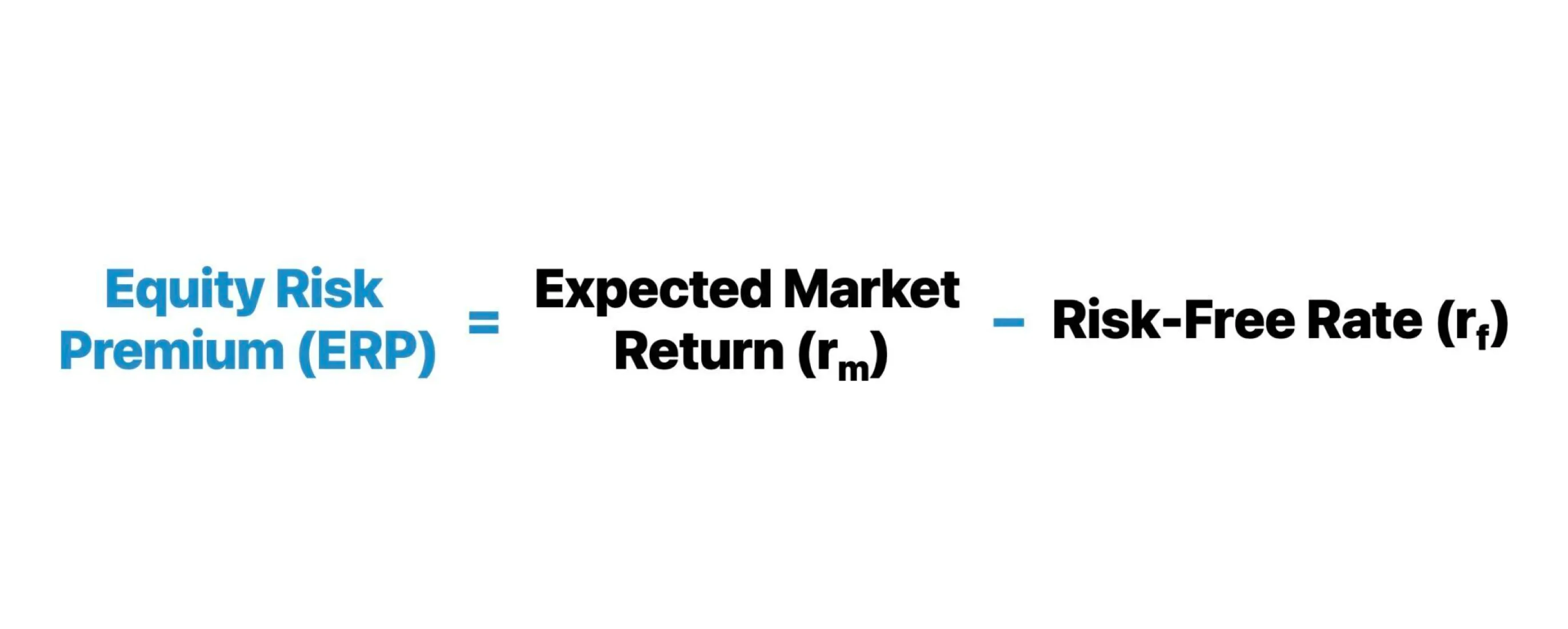
Source:WallStreetPrep
Historically in many markets, equities beat risk-free assets by several percentage points a year on average, though the exact figure varies by method and period.
Types of Risk Premiums
A quick map helps readers connect market conditions to the label in use.
-
Negative risk premium
Expected return on the risky asset sits below the risk-free premium rate. Can surface when safe yields jump or when equities get bid up so much that earnings yields sit under yields. Often linked to overvaluation talk or intense safe-haven demand.
-
Implied premium
A forward-looking estimate backed out of existing index level, expected cash flows, growth, and bond yields. Updated frequently by researchers and data providers.
-
High premium
The market demands a larger cushion in stressed regimes, during liquidity droughts, or when uncertainty rises sharply. Think wide credit spreads and cheaper equity multiples.
-
Required market premium
Required risk premium meaning a policy or practice number used in valuation and planning. For example, providers publish a “recommended” ERP for cost-of-capital work that updates with conditions.
-
Expected market premium
A model-based view of what investors expect going forward, often built from earnings and payouts. It can diverge from history for long periods.
-
Historical premium
The long-run average excess of stocks over risk-free assets. Useful context, yet not a forecast. Global studies typically land in the low-to-mid single digits depending on the benchmark.
-
Real premium
The premium after inflation, which matters for long-horizon plans and comparisons across eras.
How to Calculate Risk Premium
So, now you know the basics, and the next step is measurement. It starts with a simple subtraction, then turns practical.
Market Risk Premium Formula
The base formula (how to calculate the premium) is straightforward: Market risk premium = expected market return – risk-free rate.
Step-by-step:
-
Pick the market: Many use the S&P 500 as the equity proxy.
-
Choose the approach to expected return: historical average, survey, or forward model. A popular forward method backs the number out from index level, projected cash flows, growth, and other factors.
-
Pick the rate: Often the 10-year Treasury for USD analysis, or the maturity that matches the investor’s horizon.
-
Compute the difference: That’s the premium.
Where to source inputs: long-run S&P 500 returns and forward ERP series are published by academics and index providers. Daily Treasury yields are public.
For example, the U.S. Treasury posts the 10-year yield each trading day, and researchers such as Aswath Damodaran publish monthly implied ERPs.
Sample current-year snapshot: In mid-September 2025 the U.S. 10-year yield hovered near 4.1 percent. If a forward model suggests the S&P 500’s expected return is around 8.5 to 9 percent, the implied ERP would fall near 4.0 to 5.0 percent.
The exact figure moves with prices, earnings revisions, and yields.
Equity Risk Premium Calculation Example
A plain example of risk premium formula keeps the math clean. If an analyst expects the market to return 9 percent, and the risk-free rate sits at 4 percent, the equity premium is 5 percent. Interpretation matters. A 5 percent premium is neither high nor low in isolation, as context comes from history, liquidity, and the policy backdrop.
Some professional services publish a recommended ERP for valuation practice that may differ from a live, model-implied number. Both can be valid for different tasks.
Current Market Risk Premium
Now comes the question most readers ask: what the market risk premium is today and how to track it.
What Is Market Risk Premium Today
There is no single official print. Practitioners triangulate from:
-
Implied ERP: Updated monthly by well-known academics. As of September 1, 2025, one widely followed series placed the U.S. implied ERP near 3.7 percent.
-
Recommended ERP: Used in valuation and cost-of-capital work. In early September 2025, one provider lowered its U.S. recommended ERP to 5.0 percent, paired with either a normalized or spot long Treasury yield for the risk-free leg.
-
Live inputs: The U.S. 10-year yield sat a little above 4 percent in recent trading, which feeds the forward math.
Readings differ due to methodology, horizon, and the chosen proxy. Treat them as a range, not a single truth.
What Is the Historical Market Risk Premium
Historical context comes from century-scale datasets. The Global Investment Returns Yearbook reports that world equities beat Treasury bills by about 4 to 5 percent a year on average since 1900 in real terms, with the U.S. market showing higher long-run equity outperformance than many peers.

10-Year Historical U.S. Equity Premium (Source:S&P Global)
The history is valuable for guardrails, yet regimes change, and realized outcomes over a decade can land far from the long-run mean. Ten-year rolling windows are a practical way to visualize that drift without losing the broader anchor.
Negative Equity Risk Premium
The phrase sounds contradictory at first. It isn’t. A short map clarifies where it comes from and why it matters.
Negative Risk Premium: Core Scenarios
Can risk premium be negative? Yes. Negative ERP appears when safe yields surge or risk asset expected returns compress.
-
Flight-to-safety: Bond yields can jump on inflation repricing, then reset as growth slows. If equities have rallied into the move, the difference between earnings yield and bond yield can turn thin or negative.
-
Overvaluation in risk assets: Price gains outpace fundamentals, so the forward return implied by the index drops toward the risk-free rate.
-
Safe-haven yield spike: Yields on government bonds reach levels that compete directly with equities, pulling the ERP lower or below zero for stretches.
These phases are not permanent. They tend to show up around policy shifts, valuation extremes, or abrupt growth surprises.
Temporary vs Structural Negative Risk Premium
A temporary negative premium often tags along with a quick policy or valuation swing. For example, a rally that runs ahead of earnings or a jump in long yields during a macro scare.
A structural negative premium would signal a long phase where safe assets pay enough to rival equities on a risk-adjusted basis, which is rare. Rule-of-thumb indicators that help distinguish the two include market breadth, conditions in funding markets, and the policy path outlined by central banks.
If breadth is narrow and funding tight, the case for a cyclical dislocation is stronger than for a lasting regime.
Investor Implications of Negative Risk Premium
When the premium is thin or negative, investors often dial back position sizes, refresh hedges, and temper return assumptions. Leverage becomes more fragile in that setup. When the premium widens alongside healthy liquidity, scaling risk in a measured way can make sense for some strategies.
Process dominates prediction here: Set rules for sizing, for hedge triggers, and for re-assessment when liquidity, yields, or earnings expectations shift.
Risk Premium in Crypto Markets
Crypto adds extra moving parts. The mechanics rhyme with equities, yet the drivers can behave in bursts.
Volatility and Jump Risk
Crypto returns show fatter tails and more frequent jumps than many traditional assets. That jump risk raises the compensation investors demand and can push required premia up during stress.
Studies document clustered jumps across major coins and a material role for structural breaks, which matters for anyone interpreting a “normal” premium in this space. Liquidity microstructure on exchanges contributes to these dynamics, so the premium can move faster than in equities.
Liquidity and Funding Conditions
When liquidity thins (order books are shallow, spreads widen, risk capital sits back) required premiums widen. In contrast, abundant leverage and strong risk-on flows can compress premia too far.
Perpetual futures now dominate crypto derivatives by volume, and their funding rates nudge pricing toward spot while broadcasting risk appetite.
Watching funding, open interest, and market depth across on-exchange and off-exchange venues gives practical color on the premium’s direction of travel.
Regulatory and Technology Risk
Policy uncertainty can flip the sign on premia in a hurry. The SEC’s January 10, 2024 approval of spot Bitcoin ETPs changed market access and liquidity, while the EU MiCA regime phases in through 2024–2026 with licensing, disclosure, and stablecoin rules.
Technology risk sits beside regulation. Code exploits and bridge hacks, like the Wormhole incident, remind investors that protocol risk can reset required premia overnight.
When Crypto Premium Can Be Negative
Two patterns stand out. In severe risk-off, crypto’s jump and liquidity risk rise while risk-free yields offer shelter, so the net premium can dip below zero for a time.
During risk-on melt-ups, exuberant pricing can compress expected returns so much that the spread over the risk-free rate becomes negligible.
In both cases, spot-perp basis and funding rates deserve extra attention, and a conservative stance on leverage helps avoid forced unwinds.
Common Misconceptions
Quick errors in framing can lead to noisy readings. A short checklist clears them up.
Risk Premium vs Expected Return
The premium is not the total return. It is the excess over the risk-free rate. Example: If an investor expects 7 percent from equities and the above-mentioned rate is 4 percent, the premium is 3 percent, not 7.
Mixing the two overstates the compensation for risk and can skew allocation choices.
Time Horizon and Benchmark Errors
A one-year Treasury bill does not match a 10-year plan. Pick a risk-free proxy that lines up with the horizon used in the expected return. Keep the benchmark currency and inflation context consistent as well.
A simple checklist is best: same horizon, same currency, same inflation lens, then subtract.
“Higher Risk Always Pays More”
Markets sometimes leave risk uncompensated for stretches. Premiums can compress, or go negative, when safety yields rise or when risk assets rerate too far.
A disciplined process that watches liquidity, valuation, and policy reduces the odds of leaning into risk that is not being paid.
Actionable Use Cases for Investors
Signals are most useful when they tie back to decisions.
Portfolio Construction Lens
Treat the premium as a sizing and expectations tool. When ERP ranges are wide and liquidity is sound, diversified exposure across multiple premia (equity, duration, credit, and for some, a measured crypto sleeve) spreads the work of compounding.
A simple example might target a core equity index, a laddered mix that reflects the current yield curve, and selective diversifiers with clear risk budgets. Each sleeve carries a return assumption linked to today’s premium range, not a fixed historical figure.
Trading and Hedging Tactics
When premiums compress, some traders trim gross exposure, shorten duration on risky assets, or add hedges like index options. When premia expand alongside healthy liquidity, scaling exposure in steps rather than in one bite reduces path risk.
Funding and basis signals in crypto add another layer: If funding is rich and depth thin, care with leverage and tighter stops can limit damage from jumpy moves. Strategy still has to match risk tolerance and liquidity constraints.
Round-Up
Risk premium is the excess return over a risk-free rate, measured and managed across regimes.
Negative readings do happen when safe yields pull ahead or when risk assets price in too much optimism.
A disciplined approach (clear definitions, consistent inputs, live monitoring of implied and recommended ranges, and attention to liquidity) helps investors adapt rather than react.
FAQ
What Is a Risk Premium?
It is the extra return an investor expects for holding a risky asset instead of a risk-free one. The concept applies across equities, and digital assets.
What Is the Equity Risk Premium?
ERP is the expected return on a broad equity market minus the risk-free rate. Analysts estimate it using history, surveys, or forward models tied to prices, cash flows, growth, and yields.
What Is an Example of a Risk Premium?
If the expected return on a market index is 8 percent and the risk-free rate is 3 percent, the premium is 5 percent. That 5 percent is the compensation for bearing equity risk over the safer asset.
How Do You Calculate Risk Premium?
Pick a market, pick a risk-free rate that matches the horizon, estimate the market’s expected return, subtract. Many investors track implied ERPs and daily Treasury yields to keep the calculation current.
Can Risk Premium Be Negative?
Yes. During periods when government bond yields are high relative to equity earnings yields, or when equity expected returns compress, the ERP can dip to zero or below for a time. These episodes have emerged in recent years as yields rose and valuations lifted.
What Is the Current Market Risk Premium?
There is a range, not a single official number. As of early September 2025, one prominent implied ERP estimate sat near 3.7 percent, while a well-known recommended ERP for valuation practice was 5.0 percent.
Is a High or Low Risk Premium Better?
A higher premium offers more expected compensation, yet it often arrives during stress. A lower premium indicates richer pricing or high safe yields, which tempers forward return assumptions. The “better” answer depends on objectives, horizon, and the state of liquidity.
What’s the Difference Between Equity Risk Premium and Market Risk Premium?
In common usage they overlap. Market risk premium is often used for the broad equity market. Some contexts use “market” to mean a specific region or asset class, so definitions should be stated clearly before doing the math.
What Factors Influence Risk Premium?
Valuations, earnings outlook, interest rates, inflation trends, liquidity conditions, policy signals, and in crypto, funding and protocol risks. Shifts in any of these can widen or compress the premium quickly.
The information in this article is not a piece of financial advice or any other advice of any kind. The reader should be aware of the risks involved in trading cryptocurrencies and make their own informed decisions. SimpleSwap is not responsible for any losses incurred due to such risks. For details, please see our Terms of Service.