



Types of Stablecoins: What Really Backs Each Dollar Token

Updated: Oct 8, 2026

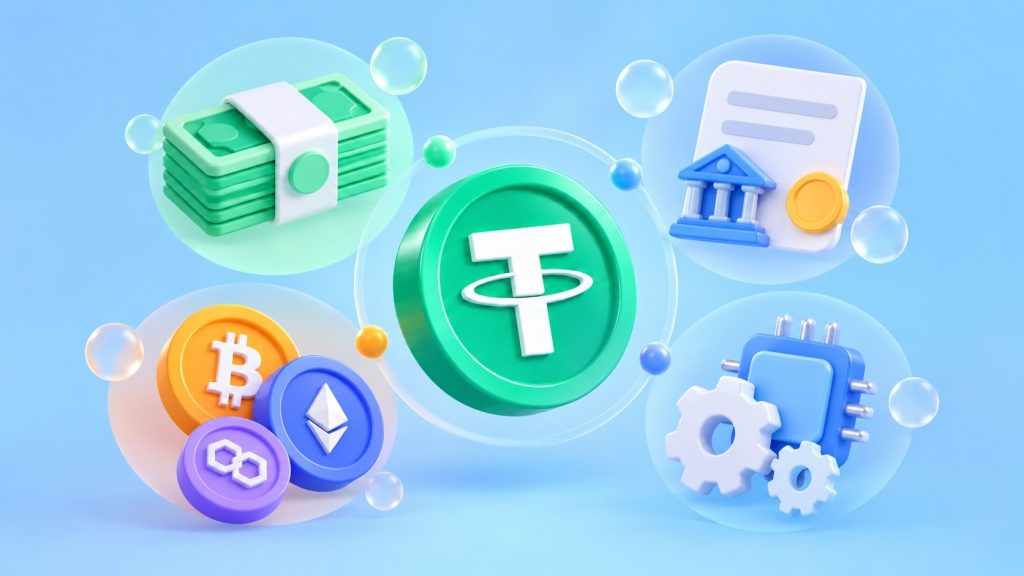
Every stablecoin promises a dollar. Behind that promise sits one of four things: cash and Treasuries in a custodian’s account, a pile of over-collateralized crypto, a hedged derivatives position, or an algorithm and a second token. Which one it is decides what happens in a crisis. This is a guide by SimpleSwap to reading the label.
Stablecoins fall into four structural types. Fiat-backed coins such as USDT and USDC hold cash and US Treasuries with a custodian and redeem one-for-one. Crypto-collateralized coins such as DAI and USDS are minted against crypto worth more than the coin, with liquidations enforcing the buffer. Synthetic dollars such as USDe hold crypto and an offsetting short futures position, keeping the combined value flat. Algorithmic coins, of which Terra’s UST was the largest, rely on a mechanism and a companion token with no external reserve, and every major one has failed. The type tells you what breaks first: a bank, a liquidation engine, an exchange or confidence itself.
The four types of stablecoins
| Type | Examples | What holds the peg | What breaks it | Track record |
| Fiat-backed | USDT, USDC, PYUSD, FDUSD | Reserves of cash, bank deposits, and short-dated US Treasuries; issuer redeems at $1 | Reserve quality, bank failure, issuer insolvency, redemption halts | USDC to $0.87 in March 2023 (SVB); USDT to about $0.85 briefly in October 2018 |
| Crypto-collateralised | DAI, USDS, LUSD, GHO | Crypto locked in smart contracts at 110% to 200%+ of coin value; liquidations sell collateral if it falls | Collateral crash faster than liquidations can run, oracle failure, governance error | DAI traded above $1.05 during March 2020 “Black Thursday” as ETH fell 50%; MakerDAO absorbed about $8M in bad debt |
| Synthetic (delta-neutral) | USDe (Ethena) | Crypto collateral plus an equal short position in perpetual futures; gains on one side offset losses on the other | Exchange counterparty failure, negative funding rates draining reserves, forced deleveraging | Operating since 2024; peg has held through several sharp drawdowns; no full-cycle stress test yet |
| Algorithmic | UST (Terra), IRON, Basis Cash | A mint-and-burn mechanism with a volatile companion token; no external reserve | Loss of confidence; the companion token collapses, and the mechanism amplifies the fall | UST: roughly $40B destroyed in May 2022; IRON: collapsed June 2021; Basis Cash: lost its peg within months of its late-2020 launch |
A fifth category is emerging: tokenized deposits and money-market funds (BUIDL, BENJI, USDY) that pay yield to holders and are structured as securities rather than payment tokens. They behave like fiat-backed stablecoins with a coupon and are typically restricted to qualified or non-US investors.
Fiat-backed: the dollar is in a bank
USDT and USDC hold most of the market. Their model is simple: you give the issuer a dollar; it gives you a token; it invests the dollar in Treasuries and bank deposits; and it promises to reverse the trade on request.
The risk sits in three places. First, the reserves: USDC holds only cash and short-dated Treasuries, while USDT also holds Bitcoin, gold, and secured loans, which are harder to sell quickly. Second, the banks: Circle’s $3.3 billion at Silicon Valley Bank was the whole reason USDC depegged in March 2023. Third, the issuer: Tether settled with the New York Attorney General in 2021 for $18.5 million over past misstatements about backing.
Both publish attestations, USDT quarterly and USDC monthly. Neither has published a full reserve audit under standard audit opinions. The GENIUS Act, signed in the US in July 2025, now requires payment-stablecoin issuers to hold reserves in cash and short-term Treasuries and to publish monthly reserve reports, which will push US-regulated issuers toward the conservative end of this range.
Crypto-collateralised: the dollar is a locked position
DAI, launched by MakerDAO in 2017 and joined by USDS after the protocol’s 2024 rebrand to Sky, works differently. A user locks ETH or other approved collateral worth, say, $150 and mints $100 of DAI against it. If the collateral falls toward the minimum ratio, the protocol auctions it to repay the debt.
The model reduces reliance on a single traditional issuer, but some crypto-collateralized stablecoins also inherit risks from centralized stablecoins and real-world assets used as collateral. It adds a race: liquidations have to sell collateral faster than the market falls. On 12 March 2020, ETH dropped about 50% in a day, Ethereum congested, and some auctions cleared at zero. Maker ended the day with $8 million in uncovered debt and covered it by minting and selling MKR. The peg recovered; the lesson was that on-chain collateral is only as good as the liquidation engine during the worst hour of the year.
Today DAI and USDS hold a large share of their backing in USDC and tokenized Treasuries, which means part of their risk is fiat-backed risk one layer down.
Synthetic dollars: the dollar is a hedge
Ethena’s USDe holds staked ETH, BTC and other collateral, then shorts an equal amount in perpetual futures. If ETH falls, the short gains; if it rises, the collateral gains. The net position stays close to flat, and the funding rate that longs pay shorts becomes yield.
The risks are specific. The short positions sit on centralised exchanges, so an exchange failure is a direct hit. Funding rates go negative in prolonged bear markets, at which point the position pays instead of earns and the reserve fund covers the gap until it cannot. The model has held its peg since launch but has not yet been tested by a multi-month downturn with sustained negative funding.
Algorithmic: the dollar is a belief
Terra’s UST was backed by nothing but the promise that one UST could always be burned for one dollar’s worth of LUNA. That works while LUNA has value. In May 2022, large UST withdrawals pushed the price below $1, arbitrageurs burned UST for LUNA and sold it, LUNA’s price fell, more UST holders ran, and the loop consumed roughly $40 billion in a week. Anchor’s 20% yield had funded the growth and guaranteed the size of the collapse.
Every algorithmic stablecoin of scale has followed the same path. The category is now largely historical, and any new project describing itself this way deserves the question: what is in the reserve, and what happens when everyone asks at once?
Reading a stablecoin like an auditor
Before trusting any stablecoin with a meaningful balance:
- Find the reserve report. Who attests it, how often, and does it list asset classes or only a total?
- Check what is in the reserve. Cash and Treasuries, or Bitcoin, loans and “other investments”?
- Check redemption terms. Can you redeem directly? At what minimum? With what delay?
- Check the depeg history. How far did it fall, for how long, and why?
- Check the freeze policy. Fiat-backed issuers can freeze addresses. Decentralised coins mostly cannot. Decide which you prefer.
- Check the jurisdiction. Where is the issuer, and under what rules? MiCA in the EU and the GENIUS Act in the US now define what a compliant stablecoin looks like in those markets.
Diversification is hygiene, not paranoia
The depegs above did not correlate. USDC fell when a bank failed and USDT did not. DAI spiked when ETH crashed and fiat coins did not move. UST collapsed and took nothing else with it except confidence. Holding two or three stablecoins of different types means a failure in one mechanism costs you a fraction rather than the whole.
This is standard practice for anyone holding cash across several banks. It is cheaper on-chain, because switching between stablecoins is a swap rather than a wire transfer.
Holding and rebalancing stablecoins with SimpleSwap
A self-custody wallet holds USDT, USDC and DAI side by side, on whichever networks you choose. Rebalancing between them does not require an exchange account.
SimpleSwap is a self-custodial swap aggregator that lists these stablecoins on their major networks. To move from one to another:
- Select the stablecoin and network you hold as the asset to send, and the stablecoin and network you want as the asset to receive.
- Choose a fixed rate to lock the quote for 20 minutes, or a floating rate.
- Paste your own wallet address for the receiving side and confirm the network.
- Send the deposit and receive the new stablecoin in your wallet after confirmation.
The quoted rate includes fees from 0.2% and is the amount you are expected to receive. SimpleSwap routes across 20+ liquidity providers, holds no long-term user balances, and requires no account for most crypto-to-crypto swaps. The only official domain is simpleswap.io.
FAQ: types of stablecoins
What are the main types of stablecoins?
What backs USDT?
What backs USDC?
Is DAI safer than USDT?
Why did UST collapse?
Which stablecoin is the safest?
Can stablecoins be frozen?
The information in this article is not a piece of financial advice or any other advice of any kind. The reader should be aware of the risks involved in trading cryptocurrencies and make their own informed decisions. SimpleSwap is not responsible for any losses incurred due to such risks. For details, please see our Terms of Service.