


How to Use Stablecoins for Payments, Savings and Cross-Border Transfers

Updated: Oct 8, 2026

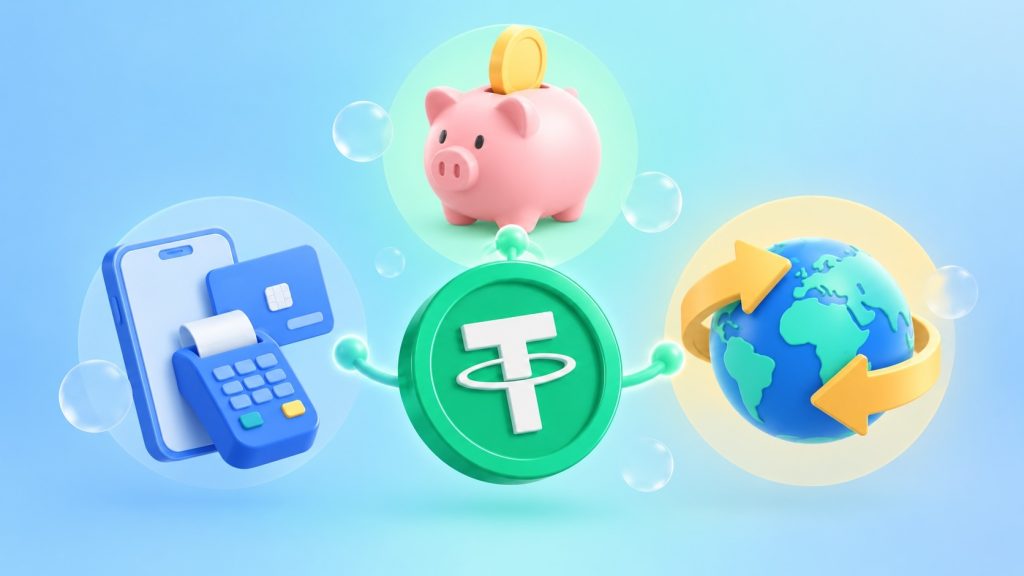
For most of the crypto industry, a stablecoin is a place to park between trades. For tens of millions of people, it is something else: the only dollar account they can open. A salary in Buenos Aires, savings in Lagos, a transfer to parents in Manila. This is the whole path, from an empty phone to money in hand, written for people who need it to work, not to be interesting.
A stablecoin such as USDT or USDC lets you hold, send, and receive US dollars from a phone without a US bank account. The full cycle has four steps: set up a wallet you control, buy stablecoins with local currency or another crypto, send them to anyone with a compatible wallet address for a fee of cents to a few dollars, and convert back to local currency through an exchange, a P2P marketplace, or a merchant who accepts them. It is faster and usually cheaper than a bank wire or a remittance service. It also carries its own responsibilities: the network has to be right, the seed phrase has to be safe, and local crypto and tax rules still apply.
Why stablecoins became everyday money in some countries
The demand is not ideological. It is arithmetic.
Inflation. In Argentina, Turkey, Nigeria, Egypt, and other economies with persistent double-digit inflation, holding local currency for a year means losing a meaningful share of it. A dollar stablecoin holds its dollar value, and unlike physical dollars, it can be bought in small amounts, stored on a phone, and sent anywhere.
Remittance costs. The World Bank’s Remittance Prices Worldwide index has put the global average cost of sending $200 at roughly 6% for years. A USDT transfer on TRON costs a few dollars regardless of amount, and often less than one when paid from staked resources.
Access. Opening a dollar account is impossible or impractical for most people in most countries. A self-custody wallet takes minutes to set up and requires no one’s permission to exist. Buying stablecoins to fund it usually requires a verified account somewhere, but the wallet itself does not.
Chainalysis’s annual geography reports show stablecoins accounting for most crypto transaction volume in several emerging-market regions, with usage concentrated in payments and savings rather than trading. The pattern is consistent: where the local currency is weak, stablecoins do the job dollars used to do.
Step 1: get a wallet you control
Start with self-custody. A custodial exchange account is convenient for buying, but a balance on an exchange is a claim on a company, and the failures of 2022 showed what that claim is worth when the company stops paying.
Choose a wallet that supports the networks you will use. TRON (TRC20) is the default rail for USDT in most emerging markets because fees are low and acceptance is wide. Ethereum (ERC20) is widely used for DeFi.. Multi-chain wallets such as Exodus and Trust Wallet cover both; hardware wallets such as Tangem and Ledger add a physical layer for larger balances. These are examples, not endorsements; download only from official sources.
When the wallet shows a seed phrase, write it on paper, keep two copies in separate places, and never enter it into a website or share it with anyone claiming to be support. Everything in the rest of this guide depends on that phrase staying private. SimpleSwap’s Safety Academy has a beginner-level walkthrough of seed-phrase storage and the scams that target it.
For the full setup, see: How to Set Up a USDT Wallet and Buy Your First Stablecoin.
Step 2: buy stablecoins
There are three common routes.
| Route | How it works | Verification | Fee level | Best for |
| Fiat on-ramp (card, bank transfer) | A payment provider converts local currency to USDT and sends it to your wallet | Identity verification required by the provider | A few percent | Small first purchases, countries with card access |
| P2P marketplace | You pay another user by local bank transfer; an exchange holds their USDT in escrow until you confirm | Account on the marketplace, usually verified | Spread set by the seller, often under 1% | Countries where cards and banks block crypto purchases |
| Swap from other crypto | You send crypto you already hold to a swap service and receive USDT | No account needed for crypto-to-crypto on self-custodial services | From 0.2% plus network fee | Anyone already holding crypto |
Whichever route you use, the destination should be your own wallet address, on the network you chose in Step 1.
Step 3: hold, and consider spreading the risk
USDT is the most accepted stablecoin in P2P and payments. USDC has a more conservative reserve profile and is the preferred coin in regulated markets. Holding both spreads issuer risk at almost no cost, since switching between them is a swap rather than a bank wire. For a comparison, see: USDT vs USDC. For the structural differences between stablecoin types.
A stablecoin does not remove risk. It replaces currency risk with issuer risk and operational risk. The first is small for the major coins. The second is entirely in your hands.
Step 4: send money across a border
This is where the model earns its name. A transfer from a wallet in one country to a wallet in another takes the same amount of time and incurs the same fee as a transfer across the street.
- Ask the recipient for their address and the network it is on.
- In your wallet, select USDT on that same network.
- Paste the address, compare the first and last characters, enter the amount, and confirm.
- Send them the transaction hash so they can track arrival.
Keep a small balance of the network’s native coin (TRX on TRON, ETH on Ethereum) to pay the fee. Never send on a network the recipient has not confirmed; wrong-network transfers are frequently unrecoverable. For a first payment to someone you do not know, Address Check in the SimpleSwap Customer Account screens their address using third-party data and returns a risk level based on known connections. For the full procedure and the mistakes to avoid, see: How to Send USDT.
Step 5: Withdraw to local currency
Three ways to turn stablecoins back into money you can spend.
- Exchange with local fiat support. Sell USDT for local currency, withdraw to your bank. Requires a verified account; takes minutes to a few days depending on the rail.
- P2P marketplace. Sell to another user who pays your bank or card directly, with the platform holding your USDT in escrow. Release only after the money is in your account, and refuse third-party payments.
- Spend directly. In many cities, merchants, landlords, and freelancers accept USDT. Crypto debit cards convert at the point of sale.
For details, timings, and the pre-withdrawal checklist, see How to Withdraw USDT Without Surprises.
The rules that still apply
Stablecoins cross borders. Laws do not disappear when they do.
- Local crypto regulation varies. Some countries license and tax crypto activity; some restrict it; a few prohibit it. Know which applies to you before you build a financial life on it.
- Taxes. Converting between currencies, including stablecoins and local money, may be a taxable event where you live.
- Service availability. Exchanges, on-ramps and swap services operate under their own terms and may not serve every jurisdiction. Check before you depend on one.
- Compliance screening. Reputable services screen transactions and may pause one for review. That is part of how they stay operational, and it is not an accusation.
Where SimpleSwap fits in the flow
SimpleSwap is a self-custodial swap aggregator. It sits in the middle of the cycle, between buying and spending, and does three things well for someone using stablecoins as everyday money:
- Converting other crypto into the stablecoin you need, on the network your counterpart uses, delivered to your own wallet. No account is required to complete a crypto-to-crypto swap.
- Moving USDT between networks, for example from Ethereum to TRON before sending to someone who only accepts TRC20, without a bridge or an exchange account.
- Rebalancing between stablecoins, USDT to USDC and back, to spread issuer risk.
The rate shown before you confirm is the amount you are expected to receive, with fees from 0.2% included. A fixed rate holds the quote for 20 minutes. SimpleSwap routes across 20+ liquidity providers, holds no long-term user balances, and applies risk-based screening to transactions. Availability is subject to SimpleSwap’s Terms of Use, including jurisdictional restrictions. The only official domain is simpleswap.io.
FAQ: stablecoins as everyday money
Can I use USDT instead of a bank account?
Is USDT safe to hold savings in?
How much does it cost to send USDT abroad?
Do I need KYC to use stablecoins?
Which is better for remittances, USDT or USDC?
Is it legal to use stablecoins in my country?
What happens if the stablecoin issuer fails?
The information in this article is not a piece of financial advice or any other advice of any kind. The reader should be aware of the risks involved in trading cryptocurrencies and make their own informed decisions. SimpleSwap is not responsible for any losses incurred due to such risks. For details, please see our Terms of Service.